TL;DR
- Private TRT in the UK costs between £50–£300 per month depending on formulation, clinic, and monitoring frequency.
- Numan and Alphagenix charge around £150–£200 monthly; established private clinics often exceed £250 with hidden consultation or review fees.
- Evernu publishes all costs upfront—no surprise charges for follow-ups, bloods, or dose adjustments.
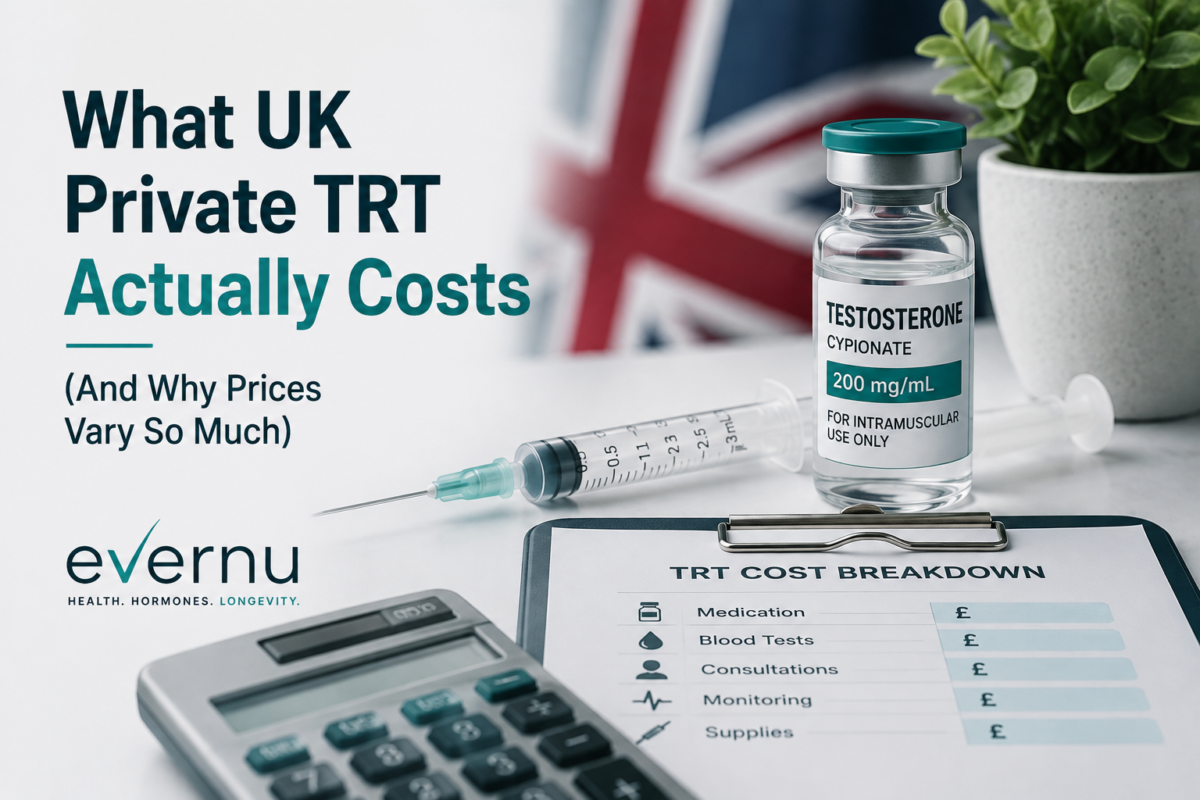
The testosterone replacement therapy cost question rarely has a clean answer. Ring five private clinics in London and you’ll get five different numbers—sometimes varying by more than 100%. That’s not incompetence; it’s the current state of the UK’s fragmented private men’s health sector. Some clinics bundle everything into one price. Others charge separately for initial consultations, monthly prescriptions, blood tests, and follow-up reviews. The gap between the cheapest and most expensive options often comes down to what’s actually included, not just testosterone in a syringe.
What follows is a transparent breakdown of what TRT really costs across the UK private market—based on published pricing from active clinics and patient feedback—plus an honest look at where Evernu sits in that spectrum and why the difference matters.
The Going Rate: What Private Clinics Charge for TRT
Let’s start with the headline numbers, because they’re all over the place.
Telemedicine-first clinics like Numan and Alphagenix have published pricing around £150–£200 per month for ongoing TRT, with initial consultations ranging from free to £80. These outfits have leaned into competitive positioning and customer-facing transparency—smart business—so their pricing pages don’t hide the total spend. Add an initial blood test (usually included or around £40) and you’re looking at a first month of roughly £200–£250.
Established private clinics—the ones with a Harley Street address or twenty years of reputation—often sit higher. We’ve seen ongoing TRT quoted at £250–£350 monthly, with initial consultations at £150–£300 and annual blood monitoring another £100–£200. A patient starting TRT at one of these practices might spend £600–£800 in year one before the medication alone kicks in.
NHS provision exists, though access is genuinely narrow. NICE guidance supports TRT for confirmed hypogonadism, but many GP practices either lack expertise or ration access to endocrinology. Waiting times for NHS TRT can stretch to 6–12 months—which is why private clinics exist and why men are willing to pay the premium.
What’s Buried in Those Numbers?
Here’s where pricing gets murky. A £150 monthly quote might exclude the blood test you’ll need at three months. It might not include the dose-adjustment consultation when you need one. Some clinics charge per follow-up review; others bundle reviews into an annual fee but charge for anything outside the standard package. One London clinic we reviewed charges £45 per GP letter to your NHS records—a routine admin task that competitors fold into their service.
The formulation matters too. Testosterone enanthate (injectable, weekly or bi-weekly) costs less than testosterone undecanoate (longer-acting, but pricier) or topical gel—which is more convenient but significantly dearer per dose. A patient choosing gel might pay £40–£60 weekly versus £15–£25 for injections. Over a year, that’s a £1,000+ difference.
Monitoring frequency affects true cost as well. Responsible clinics retest testosterone, haematocrit, and liver function at 3, 6, and 12 months—more often if doses rise. Some clinics charge per test; others cap annual bloodwork at no extra cost. This variation alone can add £300–£500 to yearly spend, depending on the model.
Why Does Evernu’s Pricing Model Stand Out?
We built our TRT pricing around transparency because we’ve seen too many men blindsided by invoices that didn’t match the initial quote.
Our current structure: initial assessment (including blood work and prescription) is £199. Ongoing testosterone replacement therapy is £99 monthly, which covers the medication, three scheduled blood-work reviews per year, and all follow-up consultations related to dose optimisation or side effect management. If you need additional testing—perhaps because you’re on other medications or have specific risk factors—we charge for it explicitly. No shock invoices. No “that consultation will be separate.”
What we don’t do: mark up blood tests, charge for brief check-in calls, or bundle in services you won’t use. If you need an annual private health summary for your records, that’s £25. If your prescription needs to be rewritten for travel, that’s included. We’ve priced ourselves to be competitive with Numan and comparable telemedicine clinics, but with an added layer of clinical rigour—we’re staffed by actual doctors, not a app with an algorithm.
Compared to traditional private practices, we’re typically 40–50% cheaper. Compared to the cheapest telemedicine options, we’re within 10–15%, though we’d argue the clinical oversight justifies that small premium.
Want to know exactly what your TRT would cost? Our free assessment shows your individual price based on your needs.
Start your free assessment →
The Hidden Costs Nobody Talks About
Beyond the clinic’s quoted price, there are peripheral expenses worth acknowledging.
Private blood tests. If your clinic doesn’t include monitoring bloodwork, you’re paying £40–£100 per panel at Medichecks, LDN Labs, or similar. Three annual tests means £120–£300 extra. Some clinics will accept NHS bloodwork from your GP if your doctor agrees to request it—a loophole that saves money but depends on local NHS relationships.
Dose adjustments and top-ups. Your initial prescription might not be your final one. Many men need a dose increase at 8–12 weeks. Some clinics charge for a new consultation and prescription; others don’t. The difference between a clinic that tweaks your dose within the existing consultation fee and one that charges £80 per adjustment adds up quickly if you’re trial-and-erroring your optimal level.
Pharmacy markup. Testosterone is prescription-only in the UK, so you’re buying via a licensed pharmacy. Most private clinics have pharmacy partnerships with known markup rates. Some are reasonable (15–25% above NHS pricing); others are extortionate (50%+). If your clinic prescribes but doesn’t process the pharmacy payment, you might be charged full retail—which can be significantly more than the clinic’s quoted “medication cost.”
Ancillary treatments. Men on TRT sometimes need ancillary medications—aromatase inhibitors if oestrogen climbs, or HCG to maintain testicular function during treatment. These aren’t always included in the base TRT price. One clinic we reviewed adds £40–£60 monthly for these add-ons if needed. That’s reasonable, but it’s a cost that creeps up if your bloods don’t look ideal.
NHS Versus Private: The Real Cost Difference
If you can access TRT via the NHS, the out-of-pocket cost is essentially zero (or £9.90 per prescription if you’re not exempt). The catch: you might wait months for an initial appointment, months more for confirmation bloodwork, and you’re entirely dependent on your endocrinologist’s preferred formulation and dosing schedule. Some NHS consultants are excellent; others prescribe cautiously—which is clinically appropriate but slower than many men are willing to tolerate.
Private clinics move faster. You can often see a clinician within 1–2 weeks and start treatment within 4–6 weeks. You also get more input into formulation choice and dose titration, which appeals to men who prefer a more active role in their own care. The private premium you’re paying is partly for speed and partly for choice.
A realistic private spend: £200 first month (assessment and blood), then £100–£150 monthly thereafter. Over a year, you’re looking at £1,400–£1,900 total. Over five years—assuming no major complications—roughly £7,000–£9,000. That’s not trivial, but it’s also not dramatically more than private physiotherapy, dental work, or gym membership over the same period. The question is whether the clinical convenience and peace of mind justify it for you.
How to Spot Underpriced and Overpriced Clinics
A price under £40 monthly for ongoing TRT is suspect. That’s below the actual cost of medication for most formulations, which means corners are cut somewhere—perhaps monitoring is minimal, or the doctor-to-patient ratio is so high that clinical oversight is nominal.
A price above £300 monthly for straightforward TRT (without significant comorbidities) is usually a red flag too. You’re paying for brand positioning, not better clinical outcomes. There are exceptions—if a clinic offers integrated physiotherapy, mental health support, or very frequent monitoring, premium pricing makes sense. But “just TRT” shouldn’t cost that much.
Red flags in pricing structures: consultation fees that don’t roll into ongoing care, blood tests charged à la carte every time, “follow-up reviews” as a separate line item, or prescriptions that go through a clinic-affiliated pharmacy at marked-up rates. Transparent clinics bundle these logically and quote a total first-year cost upfront.
Green flags: all-in monthly pricing, clearly stated what’s included, named blood-test costs, no surprises. Evernu publishes our full pricing on the website—assessment, ongoing, tests, add-ons—so you can predict your spend before booking anything.
Frequently Asked Questions
How much does TRT cost per month on the NHS?
It’s free (or £9.90 per prescription if you’re not exempt from charges). The trade-off is typically a long wait for assessment and limited choice over formulation. Many NHS trusts now offer guidelines for primary care TRT management, which can shorten timelines if your GP has experience.
Is private TRT more expensive in London than elsewhere in the UK?
Yes, noticeably. London clinics charge 20–40% more than equivalent services in Manchester, Edinburgh, or Birmingham. This reflects rent, staff costs, and patient density. Telemedicine eliminates this geographic premium, which is why online clinics tend to price more competitively nationwide.
Do I need blood tests every month?
No. Standard practice is testing at baseline, 3 months, 6 months, and 12 months, then annually thereafter if you’re stable. Frequent testing (monthly) is unnecessary unless you’re adjusting doses significantly or have specific risk factors. Clinics charging per test can inflate costs; those bundling annual bloodwork into a flat fee are more cost-effective.
Can I get TRT cheaper if I buy testosterone abroad?
You can buy it cheaper abroad, but importing it into the UK without a valid prescription is illegal. Some men do it anyway, but you lose clinical oversight, pharmacovigilance, and recourse if something goes wrong. The price saving (often 30–50%) isn’t worth the legal and medical risk.
Will my GP prescribe TRT privately and then I use my NHS prescription?
Sometimes. If your GP agrees to request blood tests and take over monitoring after a private clinic has initiated TRT, you can reduce ongoing costs significantly. Not all GPs will do this—some won’t monitor testosterone treatment at all—but it’s worth asking. You’d still pay for the initial private assessment but save on future clinic follow-ups.
The bottom line: TRT costs what it costs, and it varies because clinics structure their services differently. The cheapest option isn’t always the best value if it means skipping essential monitoring. The most expensive option often isn’t justified by superior outcomes. What matters is knowing exactly what you’re paying for upfront—no surprises, no small print, no invoice shock three months in. That’s how we approach it at Evernu, and it’s why cost-conscious men keep coming back. Ready to see your actual cost? Start with a free testosterone assessment.