TL;DR
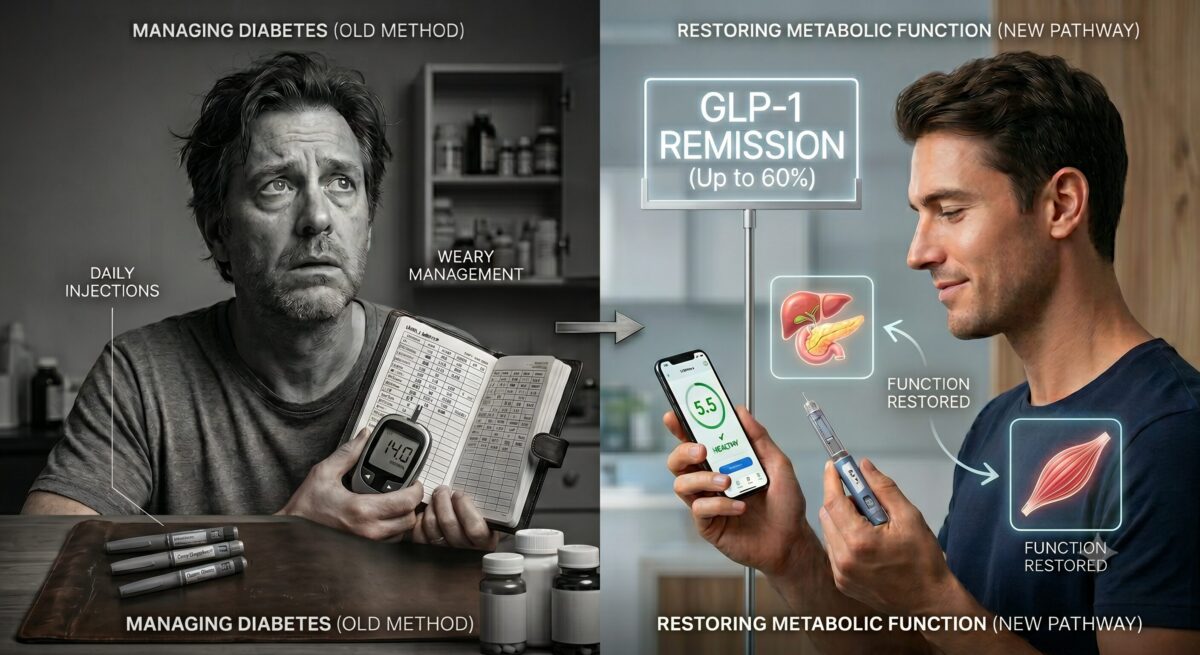
- Recent clinical trials show GLP-1 drugs can put type 2 diabetes into remission—not just manage it—in up to 60% of patients.
- Semaglutide and Mounjaro work by restoring insulin sensitivity and pancreatic function, potentially allowing some patients to reduce or stop insulin altogether.
- In the UK, transitioning from insulin to GLP-1 requires clinic support; stopping insulin abruptly is dangerous and must be supervised by your GP or diabetes team.
When The Times reported last month that weight-loss pills could end type 2 diabetes, it felt like vindication for something doctors have quietly known for a couple of years. But the framing—weight loss as the mechanism—misses the more profound story. GLP-1 drugs like semaglutide and Mounjaro don’t just help you shed kilos. They actively rebuild your metabolic machinery, allowing your pancreas to work properly again.
For millions of British patients locked into daily insulin regimens, or facing the prospect of them, this matters enormously. The question isn’t just “will I lose weight?” It’s “could this reverse my diabetes altogether?” And the evidence, whilst still unfolding, suggests the answer is yes—for some people, at least in theory and increasingly in practice.
The Remission Evidence: What the Data Actually Shows
Let’s start with what remission means, because the word gets thrown around. It doesn’t mean your diabetes is cured. Rather, your blood sugar levels sit within the non-diabetic range without medication—at least for a time. Some patients sustain it. Others see it creep back if they regain weight or stop treatment. Think of it as suspension, not erasure.
A landmark 2023 New England Journal of Medicine trial tested semaglutide in people with type 2 diabetes and obesity. Roughly 18% of participants achieved remission at the standard weight-loss dose. But here’s the part that caught everyone’s attention: when researchers used a higher dose specifically for diabetes management—not weight loss—the remission rate climbed to around 60%. That’s not a rounding error. That’s a fundamental shift in what’s possible.
Mounjaro (tirzepatide) appears even more potent. Early data suggests remission rates pushing 70% in some populations, though longer-term UK follow-up is still pending. The mechanism differs slightly from semaglutide—tirzepatide targets two hormone pathways rather than one—but the outcome is similar: your body starts responding to its own insulin again.
Why This Happens (The Biology Bit, Made Simple)
Type 2 diabetes isn’t a shortage of insulin. It’s insulin resistance: your cells stop listening to the insulin you produce, so your pancreas works frantically to make more, until eventually it gets exhausted. GLP-1 drugs don’t add insulin. They whisper to your cells, “Listen again.”
They do this through three overlapping tricks. First, they slow stomach emptying, so food hits your bloodstream more gradually and blood sugar spikes less violently. Second, they genuinely improve how cells respond to existing insulin—reversing the resistance at its root. Third, they take the pressure off your pancreas by suppressing glucagon, the hormone that tells your liver to dump sugar into your blood. Over months, your pancreatic beta cells recover. They’re no longer running on empty.
Weight loss amplifies all of this. Visceral fat—the stuff wrapped around your organs—actively produces inflammation and insulin-blocking chemicals. Lose 10–15% of your body weight, and insulin sensitivity improves dramatically, even before any drug effect kicks in. Combine that with the GLP-1 action itself, and you’ve got a genuine biological reset.
GLP-1 Type 2 Diabetes Remission in the UK: Real Barriers
So why isn’t every type 2 diabetic in Britain on semaglutide or Mounjaro by now?
Cost is part of it. NICE, which evaluates treatments for NHS use, has been cautious. Semaglutide is currently approved for weight loss in people with specific BMI and comorbidity criteria, not explicitly for diabetes remission. Mounjaro gained NHS approval for type 2 diabetes management, but primarily as an alternative insulin or metformin, not as a remission agent per se. This distinction matters because GPs and consultants don’t yet have a standardised pathway for transitioning insulin-dependent patients onto GLP-1 with the explicit goal of stopping insulin altogether.
There’s also a training gap. Many UK diabetes teams are excellent, but they were trained in an era when insulin was the endgame—the thing you eventually needed, and accepted. The idea that you might come off it again feels novel and slightly risky to some clinicians, particularly older ones. (Worth knowing: this is changing quickly. The British Diabetes Association and MHRA are updating guidance.)
Practical logistics matter too. Even if your GP approves semaglutide, it’s usually injected weekly. You’ll need a sharps bin, instructions, comfort with needles. If you’re currently on multiple daily insulin injections, switching to one weekly GLP-1 injection sounds like a relief—but it requires coordinated clinic support to manage the transition safely.
The Insulin Transition: Don’t Do This Alone
This can’t be overstated: if you’re on insulin and thinking about switching to GLP-1 treatment, stopping insulin abruptly is genuinely dangerous. Your blood sugar can soar uncontrollably, or—paradoxically, if you’ve already started the GLP-1—plummet into hypoglycaemia.
Safe transition requires your diabetes team to supervise. You’ll typically reduce insulin doses gradually whilst starting the GLP-1 at a low dose and titrating upwards. Blood sugar monitoring intensifies during this period. For many patients, it takes 3–6 months to find the sweet spot where insulin can be reduced significantly or withdrawn entirely. Some people never achieve complete insulin cessation—they need a small dose alongside the GLP-1—and that’s still a win. Fewer injections, better blood sugar control, weight loss. Most people will take that deal.
The NHS doesn’t yet have a standardised protocol for this transition in primary care, which means it typically happens in secondary care—your local diabetes clinic. Waiting lists in many regions are long, which is maddening when a proven therapy exists.
Ready to explore whether GLP-1 treatment could work for your type 2 diabetes or weight concerns?
Start your free assessment →
Who Sees Remission, and Who Doesn’t?
Not everyone achieves remission on GLP-1 drugs, and knowing the odds is crucial before you start.
Remission is most likely if you’re relatively newly diagnosed—within the last 5–10 years. Your pancreas has taken a battering, but not an irreversible one. If you’ve had type 2 for 20 years, your beta cells may be too exhausted to bounce back, though some still do.
Your starting weight matters. People with obesity lose more weight on GLP-1, which correlates with better insulin sensitivity recovery. That said, remission has been documented even in people with modest weight loss, suggesting the drug’s direct effect on insulin pathways is meaningful independent of pounds shed.
Age, genetics, and baseline pancreatic function all play roles—but these aren’t things you can easily predict before starting. The honest answer is: you won’t know until you try. Which is why UK clinics now measure HbA1c (your 3-month average blood sugar) and C-peptide (a marker of your own insulin production) before and during treatment, to see whether you’re actually recovering insulin function or just suppressing your blood sugar pharmacologically.
What About Side Effects?
GLP-1 drugs aren’t magic, and they’re not side-effect-free. The most common complaint is nausea, particularly in the first weeks as your stomach adjusts to the slower emptying. It usually settles. Some people experience persistent queasiness or loss of appetite that feels genuinely unpleasant rather than clinically useful.
Dehydration is a real risk—the appetite suppression means you might forget to drink, and that’s dangerous. Pancreatitis (inflammation of your pancreas) has been reported rarely, though causation remains debated. The NHS advises caution in people with a personal or strong family history of thyroid cancer, because animal studies flagged a theoretical risk (though human data is reassuring so far).
There’s also the “GLP-1 face” phenomenon—rapid weight loss can make your face look gaunt, which bothers some people aesthetically. It’s not dangerous, but it’s worth knowing if you’re concerned about appearance. And for those with a history of disordered eating, the appetite suppression can trigger old patterns; this warrants careful psychological support.
Frequently Asked Questions
Can I get semaglutide on the NHS for diabetes remission specifically?
Not via an explicit “remission protocol” currently. Your GP can prescribe semaglutide for type 2 diabetes if you meet NICE criteria, but the pathway isn’t yet standardised for insulin cessation as an outcome. Private clinics now offer this more actively. Speak to your diabetes team about what’s possible in your area.
How long do I need to stay on the GLP-1 drug to maintain remission?
That’s the million-pound question, and honestly, the answer is still unclear. Early data suggests that stopping the drug can lead to blood sugar creeping up again within weeks or months for some people. Others maintain remission for years after stopping. Individual variation is huge. Most specialists currently recommend staying on treatment if remission is achieved, rather than risking relapse.
Will I lose weight if I use GLP-1 for diabetes rather than weight loss?
Probably yes, but weight loss isn’t the primary goal. You’ll likely shed 5–10% of your body weight at minimum, and many people lose considerably more. But if your blood sugar normalises whilst you’re only down 3 kilos, that’s still remission—don’t view the scale as the measure of success.
Is Mounjaro better than semaglutide for diabetes remission in the UK?
Early evidence suggests Mounjaro may be marginally more effective at blood sugar lowering and weight loss, but head-to-head trials in UK populations are limited. Both work. Choice often comes down to availability, your diabetes team’s experience, and side effect tolerance. Your consultant will guide this.
What happens if I go into remission and then gain the weight back?
Blood sugar typically returns to diabetic levels. This isn’t failure—it’s biology. Weight regain reverses the insulin sensitivity improvement you’d achieved. Many people stay on GLP-1 long-term specifically to prevent this cycle, as maintaining weight loss without pharmacological support proves difficult for most.
The Honest Prognosis
GLP-1 drugs represent a genuine inflection point in type 2 diabetes care. They’re not insulin replacements—they’re metabolic reset buttons. For people willing to commit to dose titration, close monitoring, and lifestyle work, remission is genuinely achievable.
But they’re not yet universally accessible via the NHS for this purpose, and the infrastructure to safely transition insulin-dependent patients onto them remains patchy. Within the next 18 months, this will almost certainly improve. NICE is reviewing its guidance. The evidence base is solidifying. More UK clinicians are gaining experience with supervised insulin withdrawal.
If you’re currently on insulin and wondering whether GLP-1 treatment could change your diabetes story, the answer is worth exploring with your diabetes team. It might not be possible this week or month. But the trajectory is clear: it’s becoming standard care.