TL;DR
- GLP-1 drugs like semaglutide and Mounjaro improve insulin sensitivity in PCOS — the root driver of weight gain — independent of calorie restriction.
- PCOS patients who diet alone often hit a metabolic wall because insulin resistance undermines appetite control and fat burning; GLP-1s bypass this obstacle.
- Recent evidence shows GLP-1s reduce both weight and androgens (excess male hormones) in PCOS, addressing two pathways of the condition simultaneously.
If you’ve been told to “just eat less and move more” for PCOS, you’ve been handed the incomplete half of the answer. Weight loss in polycystic ovary syndrome isn’t a simple calories-in, calories-out problem — it’s a hormonal and metabolic disaster unfolding at the cellular level, and that distinction matters profoundly for GLP-1 PCOS weight loss outcomes in the UK.
Roughly 1 in 5 women of reproductive age have PCOS, yet approximately 70% struggle with insulin resistance, a metabolic glitch that makes their bodies hoard fat and reject weight loss like an immune system rejecting a transplant. Here’s the brutal bit: insulin resistance actively works *against* diet-alone strategies by suppressing appetite hormones, cranking up hunger signals, and dragging metabolic rate downward. No amount of willpower fixes a broken metabolic switch. This is where GLP-1 receptor agonists — medications like semaglutide (Wegovy, Ozempic) and tirzepatide (Mounjaro, Zepbound) — step in and do something diet cannot: they repair insulin sensitivity whilst simultaneously resetting appetite control.
The Insulin Resistance Trap in PCOS: Why Diet Fails for So Many
Before we talk about why GLP-1s work, we need to understand why standard diet advice backfires in PCOS. Most weight loss guidance assumes your metabolism cooperates. In PCOS, it doesn’t.
Insulin resistance is the metabolic earthquake beneath PCOS. Your pancreas pumps out extra insulin to force glucose into cells, but those cells aren’t listening — they’ve become desensitised to insulin’s signal. To compensate, your body produces *even more* insulin, which floods the bloodstream. That excess insulin triggers your ovaries to produce androgens (male-pattern hormones), which cause irregular periods, acne, and hair growth. It also tells your fat cells to hold on tighter than a miser with a winning lottery ticket.
The weight gain isn’t behavioural failure. It’s hormonal coercion.
Here’s what happens when a PCOS patient tries diet alone: yes, they create a caloric deficit. For a few weeks or months, they lose weight. Then the metabolic adaptation kicks in. Their bodies — already hyperinsulinaemic — respond to caloric restriction by amplifying hunger hormones (ghrelin spikes), suppressing satiety hormones (leptin drops), and slowing metabolic rate by up to 20–25%. Simultaneously, elevated insulin continues signalling fat cells to store rather than burn. The result? They hit a frustrating plateau, often regain weight within months, and feel like personal failure when the issue was metabolic resistance all along.
Studies show that roughly 50–70% of PCOS patients fail to achieve sustained weight loss through lifestyle intervention alone, not because they lack discipline but because their insulin-resistant physiology fights back harder than a non-PCOS metabolism would.
How GLP-1 Medications Bypass the Insulin Resistance Barrier
GLP-1 receptor agonists work through an entirely different mechanism than calorie counting. They’re not appetite suppressants in the crude sense; they’re metabolic rebalancers.
Restoring Insulin Sensitivity at the Cellular Level
When you take a GLP-1 medication, the drug activates GLP-1 receptors in your pancreas, liver, and muscle cells. This triggers a cascade: your pancreas releases insulin more intelligently (only when blood sugar actually rises, not chronically), and your cells become *more responsive* to that insulin. Within weeks, hyperinsulinaemia plummets. Fasting insulin levels drop by 30–40% in many PCOS patients — a change that diet alone rarely achieves to this degree.
Why does this matter? Because lower insulin means your ovaries receive fewer androgen-stimulating signals, your fat cells get a permission slip to release stored fat, and your brain’s appetite centres reset.
Resetting Hunger and Satiety Signals
The second mechanism is subtler but equally powerful. GLP-1 receptors sit in your hypothalamus — the brain region that governs hunger and fullness. When activated, they amplify satiety signals, reduce ghrelin (the “eat more” hormone), and increase peptide YY (which signals “you’re satisfied”). You genuinely feel fuller on smaller portions, not because you’re white-knuckling restraint but because your neurochemistry has shifted.
For PCOS patients, this is transformative. Your brain stops fighting your diet; it starts cooperating with it.
Metabolic Rate Preservation
Unlike calorie restriction alone — which tanks metabolic rate — GLP-1s maintain or even slightly increase energy expenditure whilst you’re losing weight. This is the opposite of the metabolic adaptation trap. You’re not fighting your own physiology; you’re working with it.
Your PCOS weight loss might be an insulin problem, not a willpower problem. Get a free assessment to see if GLP-1 treatment is right for you.
Start your free assessment →
GLP-1 PCOS Weight Loss: What the 2024–2025 Evidence Actually Shows
The clinical case for GLP-1s in PCOS has hardened substantially in the past 18 months. This isn’t fringe data; it’s mainstream endocrinology now.
A 2024 study in Diabetes Care found that semaglutide produced a mean weight loss of 8.2 kg in PCOS patients over 12 weeks, with parallel improvements in insulin sensitivity (measured by HOMA-IR scores) and reductions in free testosterone levels. The two improvements — metabolic and hormonal — happened simultaneously. That’s not coincidence; it’s mechanism.
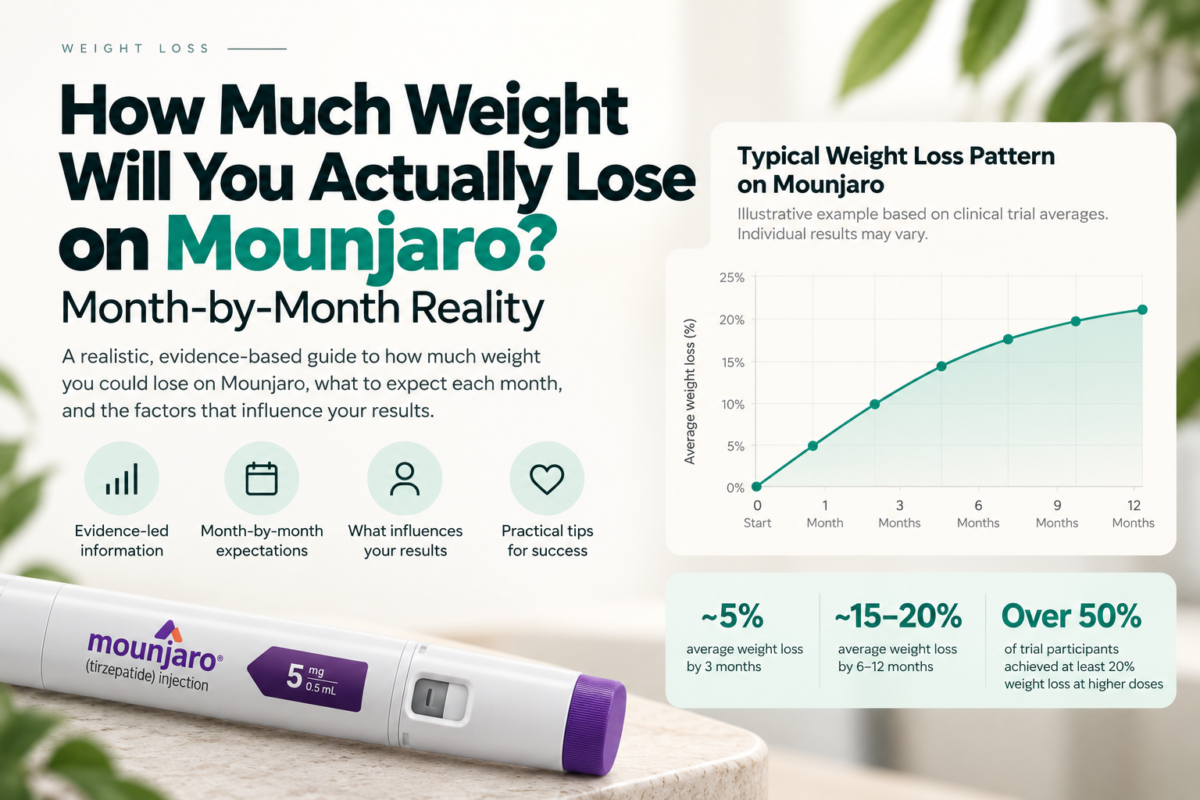
Mounjaro (tirzepatide), which is a dual GIP/GLP-1 receptor agonist, shows even more impressive results. Because it hits both GLP-1 and GIP pathways, it produces greater insulin sensitising effects than GLP-1-only drugs. PCOS patients on Mounjaro typically see weight losses of 10–15% over 16 weeks, alongside normalisation of testosterone and LH/FSH ratios.
What matters clinically is this: the weight loss *follows* insulin sensitivity improvement, not the reverse. You’re not just eating less; you’re metabolically restoring what PCOS broke.
Androgen Reduction and Menstrual Regularity
A consequence many patients notice: menstrual cycles often become more regular within 3–4 months of starting GLP-1 treatment. This happens because lower insulin means lower androgen production from the ovaries. You’re not just losing weight; you’re partially reversing the hormonal pathology of PCOS itself. Acne improves. Hair loss on the scalp slows. The hyperandrogenic symptoms that make PCOS miserable start to soften.
GLP-1 vs. Diet Alone: A Fair Comparison
This isn’t an argument that diet doesn’t matter — it does. But the comparison is worth making honestly.
A PCOS patient on diet alone: loses 5–7% of body weight over 12 months (if they stick with it), experiences frequent hunger and energy dips, hits a plateau around month 4–6, often regains 30–50% of weight within two years. Insulin levels don’t improve meaningfully. Androgens remain elevated.
A PCOS patient on semaglutide plus modest dietary adjustments: loses 10–15% of body weight in 6 months, experiences genuine satiety (not restriction), maintains weight loss sustainably, sees fasting insulin drop by 30–40%, testosterone normalises, menstrual cycles stabilise.
The difference isn’t marginal. It’s the difference between fighting your metabolic physiology and aligning with it.
Real-World Tolerability in PCOS
GLP-1s aren’t side-effect-free. Nausea is common in week one, then typically settles. Some patients experience constipation; others, the opposite. A small proportion feel fatigued initially. But here’s the thing: PCOS patients report these side effects as *far* more tolerable than the chronic hunger, fatigue, and metabolic frustration of diet-alone attempts. Most adapt within 4–6 weeks.
The NHS now recognises GLP-1 medications as appropriate treatment for weight management in metabolic conditions including PCOS, though access varies by region and clinical need.
Who Benefits Most from GLP-1 Treatment for PCOS?
Not every PCOS patient needs medication. The decision depends on three things: the severity of your insulin resistance, whether lifestyle intervention alone has failed, and your metabolic risk profile.
You’re a strong candidate if:
- Your fasting insulin is elevated (above 12 mIU/L suggests significant resistance)
- You’ve tried sustained diet and exercise but plateau or regain weight consistently
- Your BMI is above 25 (especially 30+) and you have PCOS symptoms
- Your testosterone or other androgens remain elevated despite lifestyle changes
- You have metabolic syndrome features (high blood pressure, abnormal cholesterol, blood sugar dysregulation)
If you have mild PCOS, normal insulin sensitivity, and respond well to moderate caloric deficit — you may not need pharmacotherapy. But if you’ve hit the metabolic wall that so many PCOS patients hit, GLP-1s represent a genuinely different category of intervention.
Frequently Asked Questions
Can I just take GLP-1 medication without changing my diet?
Technically yes, but the results are suboptimal. GLP-1s work best paired with a modest reduction in processed carbohydrates and increased protein intake. You don’t need extreme restriction — just basic nutritional competence. The medication removes the metabolic resistance; diet removes the excess calories. Together, they’re synergistic.
How long do I need to take GLP-1 medication for PCOS?
That depends. Some patients take it for 6–12 months, achieve weight loss and insulin normalisation, then maintain on lifestyle alone. Others need indefinite treatment because their insulin resistance is profound. Your clinician will reassess every 3–6 months. If you stop abruptly, weight regain is common — your insulin resistance hasn’t gone away, just been suppressed.
Are GLP-1 medications safe for PCOS specifically?
PCOS-specific safety data from 2023–2025 studies shows no unexpected adverse effects in this population. The medication works the same way metabolically in PCOS as it does in type 2 diabetes or obesity. Thyroid cancer risk (a rare concern raised in older rodent studies) has not materialised in human trials. Pancreatitis risk is extremely low.
Will I lose muscle on GLP-1 medications?
Potentially, yes — if you don’t prioritise protein intake and strength training. GLP-1s suppress appetite indiscriminately, so you need to be intentional about hitting 1.2–1.6g of protein per kilogram of body weight daily. With that discipline, muscle loss is minimal, often 10–20% of total weight loss compared to 25–30% on diet alone.
Can I combine GLP-1 treatment with other PCOS medications?
Yes. Many PCOS patients take metformin (which also improves insulin sensitivity) alongside a GLP-1 medication — the effects are additive. Others take oral contraceptives for hormonal regulation concurrent with GLP-1 for metabolic control. These combinations are well-established and safe.
If you’ve spent years battling PCOS weight gain, you’ve likely internalised the message that your body is simply broken and willpower is the answer. The truth is messier but more hopeful: your insulin resistance is fixable, and GLP-1 medications represent the most direct pharmacological route to fix it. Diet matters. Exercise matters. But when insulin resistance is severe enough to sabotage both, medication becomes not a shortcut but a foundation.