If you have just been prescribed Mounjaro (tirzepatide) or you are weighing up whether it is right for you, the question at the front of your mind is almost certainly: how quickly will I actually see results?
It is a fair question, and the honest answer is that there is no single timeline that applies to everyone. Your starting weight, metabolic health, lifestyle habits, and how your body responds to the medication all play a role. What we can do is walk you through what the clinical evidence shows, what most patients across England, Scotland, Wales, and Northern Ireland tend to experience, and how to set realistic expectations so you do not lose motivation during the early weeks.
What Is Mounjaro and How Does It Work?
Mounjaro contains the active ingredient tirzepatide. Unlike older GLP-1 receptor agonists such as semaglutide (the ingredient in Wegovy and Ozempic), tirzepatide is a dual-action medication. It targets two hormone receptors simultaneously:
- GLP-1 (glucagon-like peptide-1): Signals the brain that you are full, slows the rate at which food leaves your stomach, and helps regulate blood sugar levels.
- GIP (glucose-dependent insulinotropic polypeptide): Works alongside GLP-1 to further influence appetite, insulin sensitivity, and how efficiently your body processes and stores energy.
This dual mechanism is the reason Mounjaro has produced some of the most impressive weight-loss figures seen in clinical trials to date. But impressive trial averages and your personal experience in the first few weeks may look quite different, and understanding why is key to sticking with treatment.
Mounjaro Weight Loss Timeline: Week by Week
The following timeline draws on data from the SURMOUNT-1 clinical trial published in the New England Journal of Medicine, combined with the real-world experience of prescribers. Think of it as a general map rather than a precise sat-nav route; your journey may vary.
Weeks 1 to 2: The Adjustment Phase (2.5 mg Starting Dose)
Everyone begins Mounjaro on the lowest dose of 2.5 mg. This is not the dose that drives significant weight loss. It exists to let your body acclimatise to the medication and to minimise side effects.
What most people notice:
- A subtle reduction in appetite. You might find yourself leaving food on your plate without consciously trying.
- Feeling satisfied sooner during meals.
- Possibly some mild nausea, bloating, or changes in bowel habits as your digestive system adjusts.
What the scales may show: Minimal change, or perhaps a kilogram or two, often attributable to water fluctuations rather than fat loss. Try not to fixate on the number just yet.
This phase can feel frustrating if you were expecting dramatic results from day one. It helps to remember that the appetite changes you are feeling are the medication working. The scale catches up later.
Weeks 3 to 4: Early Momentum Builds
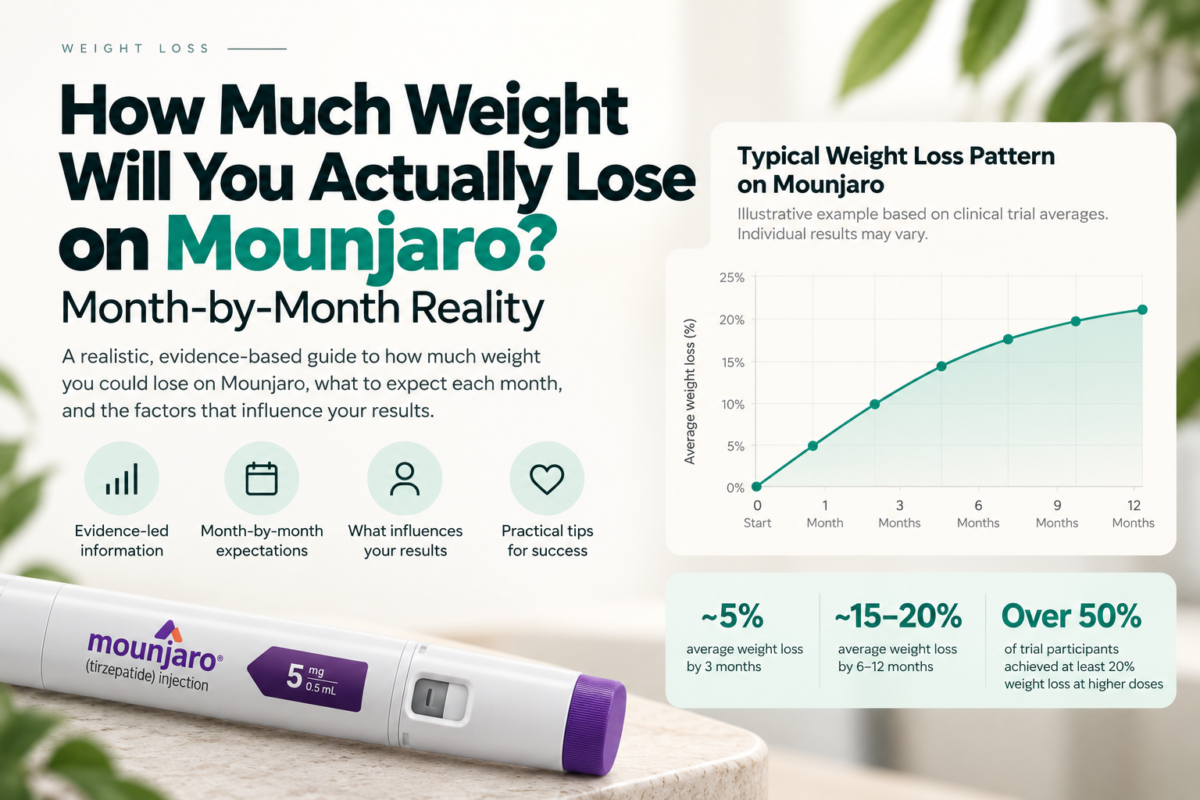
By the end of the first month, the SURMOUNT-1 data shows that participants had typically lost between 2% and 4% of their starting body weight. For someone weighing 100 kg, that is roughly 2 to 4 kg.
What most people notice:
- Appetite suppression becomes more consistent and reliable.
- Food noise, that constant background chatter about what to eat next, starts to quieten down.
- Clothes may begin to fit a little differently, particularly around the waist.
- Side effects, if present, often begin to settle as your body adapts.
Your prescriber will typically keep you on 2.5 mg for four weeks before considering an increase to 5 mg. Each dose escalation is an opportunity for your body to adjust gradually.
Weeks 5 to 8: Visible Changes Begin
This is the period when many patients report the first comments from friends or colleagues. You are now likely on 5 mg, and the dual GLP-1/GIP action is having a more pronounced effect on appetite and metabolism.
What the evidence suggests: Many users have lost around 5% to 6% of their initial body weight by week eight. For context, clinical guidelines from NICE (the National Institute for Health and Care Excellence) consider a 5% weight loss to be clinically meaningful, associated with measurable improvements in blood pressure, blood sugar, and cholesterol.
What most people notice:
- More reliable portion control without relying on willpower.
- Improved energy levels, partly from the weight loss and partly from more stable blood sugar.
- Better sleep for some patients, particularly those who had been experiencing sleep apnoea symptoms.
Weeks 9 to 12: Established Progress
By the three-month mark, many patients in the SURMOUNT-1 trial had lost between 9% and 12% of their starting body weight. This is the stage where the difference is unmistakable, both on the scales and in the mirror.
Most prescribers will have titrated patients up to 7.5 mg or 10 mg by this point, depending on tolerance and response. The dose increase is not automatic; it is a clinical decision based on how you are responding and whether side effects are manageable.
What most people notice:
- A noticeably different relationship with food. Cravings for high-calorie foods often diminish significantly.
- Clothing sizes changing, sometimes by one or two sizes.
- Improvements in blood markers if you have conditions like type 2 diabetes, high cholesterol, or elevated blood pressure.
Week 13 and Beyond: Long-Term Results
Patients who continue on Mounjaro at higher maintenance doses (10 mg or 15 mg) can expect ongoing, steady progress. The SURMOUNT-1 trial recorded average weight losses of:
- 5 mg dose: approximately 16% of body weight over 72 weeks
- 10 mg dose: approximately 21.4% of body weight over 72 weeks
- 15 mg dose: approximately 22.5% of body weight over 72 weeks
To put those numbers into perspective, for someone starting at 100 kg, the highest dose group averaged a loss of around 22.5 kg over the course of the trial. These are among the most significant results ever recorded for a weight-management medication.
It is important to note that weight loss does tend to plateau at some point. This is a normal physiological response, not a sign that the medication has stopped working. Your prescriber can help you understand what to expect and when.
Why Some People See Results Faster Than Others
If you are on a Mounjaro forum or support group and someone else is losing weight faster than you, it can feel discouraging. But the variation is completely normal. Several factors influence your personal timeline:
Starting BMI and Body Composition
People with a higher starting BMI often see larger absolute weight losses in the early weeks, partly because their body has more excess weight to mobilise. However, the percentage of weight lost tends to be broadly comparable across starting weights over time.
Dose Progression
If your prescriber keeps you on a lower dose for longer (which is sometimes the right clinical decision), your results may build more gradually. This is not a failure; it is a cautious, patient-centred approach.
Diet Quality and Protein Intake
Mounjaro reduces your appetite, but it cannot choose your meals for you. Patients who prioritise protein (aiming for around 1.2 to 1.6 g per kilogram of body weight daily) tend to preserve more lean muscle mass while losing fat, which keeps metabolism healthier and supports long-term success.
Physical Activity
You do not need to become an athlete. Regular movement, even brisk walking, resistance training, or swimming, supports fat loss, protects muscle, and improves mood. The NHS recommends at least 150 minutes of moderate activity per week for adults.
Sleep and Stress
Chronic stress raises cortisol, which encourages the body to hold onto abdominal fat. Poor sleep disrupts hunger hormones (ghrelin and leptin), making appetite harder to manage even with medication. Addressing these factors can meaningfully influence your results.
Underlying Health Conditions
Conditions such as hypothyroidism, polycystic ovary syndrome (PCOS), insulin resistance, and certain medications (including some antidepressants and corticosteroids) can slow weight loss. If you have any of these, your prescriber will take them into account when setting expectations.
What If Mounjaro Does Not Seem to Be Working?
If you are several weeks in and the scales have barely moved, do not panic. Here are a few things to consider before assuming the medication is not working for you:
- Look beyond the scales. Are your clothes fitting differently? Has your waist measurement changed? Are you eating less without trying? These are all signs the medication is doing its job, even if your weight has not shifted dramatically.
- Check your hydration. Water retention can mask fat loss. Hormonal fluctuations, sodium intake, and even the weather can influence how much water your body holds.
- Review your eating patterns. Mounjaro reduces appetite, but liquid calories (alcohol, sugary drinks, high-calorie coffees) and grazing on high-calorie snacks can still add up.
- Talk to your prescriber. A dose increase, dietary tweaks, or investigation into underlying conditions may be the next appropriate step.
Mounjaro Side Effects: What to Expect and When They Ease
Side effects are most common during the first few weeks and following each dose increase. The most frequently reported include:
- Nausea (tends to improve within 1 to 2 weeks at each dose level)
- Diarrhoea or constipation
- Bloating and indigestion
- Fatigue during the adjustment period
- Injection-site reactions (minor redness or itching)
Most gastrointestinal side effects diminish as your body adapts. Eating smaller, more frequent meals, staying hydrated, and avoiding very fatty or greasy foods can all help manage symptoms during the early weeks.
Serious side effects are uncommon but include pancreatitis (severe abdominal pain radiating to the back) and allergic reactions. If you experience these, seek medical attention immediately. The NHS guidance on tirzepatide provides a comprehensive list of side effects and when to get help.
Setting Realistic Expectations
One of the most important things to understand about Mounjaro, or any weight-loss medication, is that it is a tool, not a magic solution. The patients who see the best long-term outcomes tend to be those who:
- Combine the medication with sustainable dietary improvements rather than crash dieting
- Incorporate regular physical activity they actually enjoy
- Attend regular check-ins with their prescriber
- Set process goals (eating protein at every meal, walking daily) rather than fixating solely on a target number
- Accept that plateaus are normal and temporary
Weight management is a long-term commitment. Mounjaro can make the journey significantly easier, but it works best as part of a broader approach to your health.
Ready to Find Out If Mounjaro Is Right for You?
At Evernu, our prescribers can assess your eligibility and build a personalised treatment plan. Our online assessment takes just a few minutes, and there is no obligation to proceed.
Start your free medical assessment today
Frequently Asked Questions
How long does Mounjaro take to suppress appetite?
Most patients notice a reduction in appetite within the first one to two weeks of starting treatment, even on the initial 2.5 mg dose. This is often the first sign the medication is working, and it typically precedes visible weight loss on the scales by several weeks.
Can I speed up my Mounjaro results?
While you cannot safely rush the dose titration schedule, you can optimise your results by eating a protein-rich diet, staying physically active, sleeping well, and managing stress. These factors work alongside the medication to support both fat loss and muscle preservation.
Is the weight loss from Mounjaro permanent?
Clinical evidence suggests that weight regain is common if the medication is stopped without having established sustainable lifestyle changes. Many patients continue treatment long-term with medical supervision. Your prescriber will discuss the best approach for your circumstances.
How does Mounjaro compare to Wegovy for speed of results?
Both medications begin working within the first few weeks, but Mounjaro’s dual GLP-1/GIP mechanism has shown slightly greater average weight loss in clinical trials (up to 22.5% versus approximately 15% to 20% for Wegovy over similar timeframes). Individual responses vary, and the best medication for you depends on several clinical factors.
Do I need to follow a specific diet while taking Mounjaro?
There is no mandatory diet plan, but prioritising protein, vegetables, fibre-rich carbohydrates, and healthy fats will support your results and help minimise side effects like constipation. Your prescriber or a dietitian can help you develop an eating pattern that works for your lifestyle.
Explore Weight Loss Treatments at Evernu
We offer clinician-led weight-loss programmes with ongoing support, delivered discreetly across the UK. Learn more about how Mounjaro and other treatments could fit into your health goals.
View our weight loss treatments