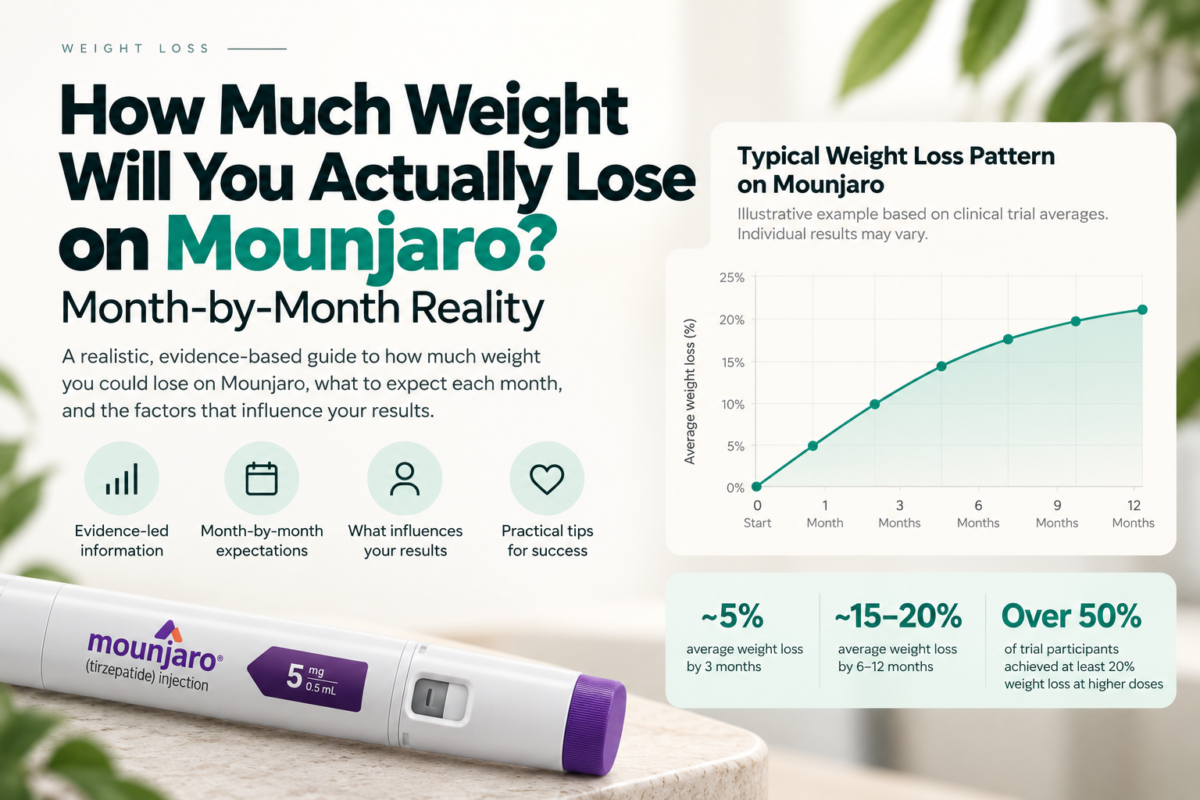
TL;DR
- GLP-1 drugs like semaglutide and Mounjaro work brilliantly for weight loss, but you can shed 20–30% of that loss as muscle rather than fat if you’re not deliberate about it.
- Resistance training, adequate protein (1.6–2.2g per kg of bodyweight), and clinician-supervised monitoring are proven muscle-sparing strategies — not optional add-ons.
- Evernu’s clinician-led approach includes exercise protocols and nutritional oversight built in, unlike pharmacy-only models that focus solely on drug efficacy.
You’ve probably heard the term “Ozempic butt” floating about on social media — and whilst it sounds like a punchline, there’s something genuinely worth taking seriously underneath the headline. When you lose weight rapidly on GLP-1 receptor agonist medication, your body doesn’t automatically burn fat and preserve muscle. Without proper intervention, you risk losing a worrying chunk of lean tissue alongside the fat. That’s not aesthetic vanity. That’s metabolic trouble waiting to happen.
A 2024 analysis in the New England Journal of Medicine found that people losing weight on semaglutide and tirzepatide shed between 20 and 30% of their total weight loss as muscle if they weren’t actively strength training. For someone dropping 20kg, that could mean 4–6kg of muscle gone. That matters because muscle tissue drives your metabolic rate, supports your bones, keeps you strong, and — let’s be honest — shapes how you look at the end of it all. The good news? This outcome isn’t inevitable. It’s preventable with the right approach, and it’s exactly the kind of nuance that separates clinician-supervised weight loss from a simple prescription posted through your letterbox.
Why GLP-1 muscle loss happens — and why it’s different from regular dieting
Here’s the mechanism, stripped of the jargon. GLP-1 drugs (semaglutide, tirzepatide, dulaglutide) work by slowing gastric emptying and signalling fullness to your brain. You eat less. Full stop. Your calorie deficit deepens rapidly — often far more aggressive than you’d achieve through diet alone. That’s their superpower.
But there’s a catch. When you’re in a steep calorie deficit, your body needs energy. It doesn’t automatically reach for fat stores first. Muscle tissue is metabolically active and expensive to maintain. If your brain doesn’t get strong signals that muscle is necessary — through loading, stress, and adequate protein — your body happily cannibalises it to fuel your deficit. It’s not stupidity; it’s evolutionary logic. Your muscles used to be your main defence against starvation, but modern survival doesn’t need a 40kg bicep, so if you’re not using it under load, your body shrugs and converts it to fuel.
The difference between GLP-1 dieting and traditional calorie restriction is speed and depth. A sensible conventional diet creates a 500-calorie daily deficit. You might hit that through exercise and portion control. A GLP-1 patient often finds themselves 800–1200 calories below baseline without trying, because they’re genuinely not hungry. That aggressive deficit, maintained week after week, is where muscle loss accelerates. Add in the fact that many people starting GLP-1 treatment are sedentary, deconditioned, or recovering from years of weight-related physical limitations — and you’ve got a perfect storm for muscle atrophy.
The evidence on resistance training and protein — what actually stops muscle loss on semaglutide
This is where the picture brightens.
The muscle-sparing effect of resistance training is one of the most robust findings in exercise physiology. A study published in Obesity last year compared GLP-1 patients who strength-trained three times weekly against those who didn’t. The training group retained 87% of their lean mass during weight loss; the non-training group retained only 62%. The difference wasn’t marginal.
Protein matters equally. Your muscles are built from amino acids, and when you’re losing weight, dietary protein acts as a scaffolding — it signals your body to keep muscle tissue around. The current consensus from sports medicine and bariatric guidelines is clear: aim for 1.6 to 2.2 grams of protein per kilogram of bodyweight daily if you’re strength training during a deficit. For a 100kg person that’s 160–220g daily. That’s higher than standard recommendations (0.8g/kg) because you’re fighting against catabolism.
The combination is what counts. Protein without resistance training helps, but not dramatically. Resistance training without adequate protein is similarly blunted. Together, they’re the difference between losing 20kg of fat and 5kg of muscle, versus 20kg of fat and 10kg of muscle. Over a year-long programme, that’s a genuinely different body composition outcome.
Does this mean hours in the gym? No. Three sessions weekly of 30–40 minutes, focusing on compound movements (squats, deadlifts, chest presses, rowing) that engage large muscle groups, is sufficient. You’re not training for aesthetics (though that follows); you’re training for metabolic survival. The signal to your muscles is: you’re still needed.
How Evernu’s approach differs from pharmacy-only models
Most GLP-1 prescriptions in the UK follow a predictable pattern. You fill a questionnaire. A clinician reviews it. A pharmacist dispenses the medication. Six weeks later, you’re told “come back when you run out.” The drug works. Weight drops. Everyone’s happy. Until you glance in the mirror and notice your face has hollowed, or your trousers fit but feel different, or you’re exhausted climbing stairs you used to skip two at a time.
That’s the gap. Pharmacy-only services optimise for one metric: drug efficacy. Clinician-supervised programmes should optimise for the outcome you actually want: sustainable, metabolically healthy weight loss that doesn’t dismantle your body composition in the process.
At Evernu, we supervise GLP-1 treatment differently. Our approach includes structured exercise protocols tailored to your current fitness level, nutritional oversight focused on hitting your protein targets, and regular body composition monitoring — not just scale weight — so we catch muscle loss early. If it’s happening, we adjust: maybe increasing training intensity, or adding a protein supplement, or slightly adjusting your medication dose to moderate the deficit.
You’re not alone on a phone with a pharmacist. You’re working with a clinician who’s monitoring how your body is actually changing, not just whether the drug is working. That distinction sounds subtle. It’s not. It’s the difference between weight loss and the kind of transformation that lasts.
Worried your GLP-1 treatment might cost you muscle? Our clinicians assess your individual risk and build a muscle-sparing protocol into your programme from day one.
Start your free assessment →
Practical steps you can take right now
Start resistance training before you increase your dose
If you’re just beginning GLP-1 treatment, establish a strength routine in your first few weeks — whilst your appetite is only moderately suppressed. It’s far easier to lock in the habit before you’re struggling to eat 1200 calories. Your dose will increase in 0.25mg increments; use that time to find your training rhythm.
Track protein, not just calories
Your phone’s calorie-counter app is useless if it doesn’t flag protein totals. Switch to one that does (MyFitnessPal, Cronometer). Aim for 30–40g per meal, spread across the day, rather than front-loading it. Your GLP-1 medication will limit portion size anyway, so protein density per bite matters more than total volume.
Measure body composition, not just weight
Scales lie. A DEXA scan (dual-energy X-ray absorptiometry), bioelectrical impedance analysis, or even simple tape measurements every 6–8 weeks reveal what’s actually happening to your lean mass. If you’re losing 2kg weekly but none of it is muscle, you’re winning. If 40% of your loss is muscle, something needs changing.
Eat in a controlled deficit, not by accident
GLP-1 naturally creates a deficit, but haphazard undereating — skipping meals because you’re not hungry, picking at food, grazing instead of eating proper portions — makes protein targets almost impossible. Aim for three deliberate meals daily, even if they’re small. Structure beats hunger suppression.
Frequently Asked Questions
Can I prevent all muscle loss on Ozempic or Mounjaro?
Not entirely, but you can get close. A modest amount of lean mass loss (5–10%) during significant weight loss is normal and often reflects water and glycogen, not tissue atrophy. The goal isn’t zero loss; it’s preventing the catastrophic 25–30% that happens without intervention. With proper training and nutrition, you should preserve 75–85% of your lean mass, which translates to fat loss that’s genuinely fat.
Do I need to join a gym or hire a personal trainer?
No. Bodyweight exercises, resistance bands, and dumbbells work just as well as a fancy gym membership. What matters is progressive overload — adding slight resistance or reps weekly — and consistency. Your garden or living room is enough. A trainer is helpful for form and programme design, but not essential; many people follow YouTube coaches or use app-based programmes successfully.
What if I’m too tired to train whilst on GLP-1?
Fatigue is real, especially in the first 4–6 weeks as your body adjusts. Start gently — 20-minute sessions, lower intensity — and expect energy to return as you stabilise. If fatigue persists beyond 8 weeks, that’s worth discussing with your clinician. Sometimes it signals inadequate protein or a dose that’s too aggressive; occasionally it’s underlying anaemia or thyroid dysfunction. Don’t push through exhaustion; report it and adjust.
Do I need to eat more to preserve muscle?
Counterintuitively, no — not more total calories. You need better distributed calories: more protein, timed around your training. A 1500-calorie diet with 150g of protein and structured training beats 2000 calories of carbs and fat with no exercise. Protein essentially lets you stay in a deficit whilst signalling your body to keep muscle. It’s the tool that makes muscle preservation possible despite weight loss.
Will my results last once I stop GLP-1 treatment?
Only if your habits do. The medication is a tool that makes a deficit easier to sustain; it doesn’t rewire your appetite regulation permanently (though appetite suppression does gradually fade). Patients who keep training and eating well maintain their weight loss. Those who treat GLP-1 as a magic wand and revert to old patterns regain weight quickly, often preferentially as fat because they’ve now got less muscle to support their baseline metabolism. Build habits alongside the drug.
The bottom line
The fact that your body might shed muscle during rapid weight loss isn’t a reason to avoid GLP-1 treatment — these drugs work, and their benefits for people carrying significant excess weight are profound. It’s a reason to treat the process with intention rather than passivity. Three weekly sessions of resistance training, hitting your protein targets, and clinician oversight that tracks body composition, not just scale weight, transforms the outcome. You’re not just losing weight; you’re reshaping how you’re built. That’s worth getting right.