If you have ever lost weight only to watch it gradually return, you are not alone and you are not failing. The statistics on long-term weight maintenance are, at first glance, genuinely discouraging. Research from Stanford Medicine suggests that 80 to 85 percent of people who lose a significant amount of weight go on to regain it. That is a figure that gets quoted frequently, often without much context, and it can make the whole endeavour feel futile.
But here is what those headlines tend to leave out: that statistic tells you the average outcome, not your outcome. It reflects what happens without structured maintenance strategies, not what happens when people approach the problem with awareness, planning, and support. And even partial maintenance, keeping off some but not all of the weight you lost, produces meaningful health benefits that are often underappreciated.
So is it possible to maintain weight loss? Yes. Is it easy? No. Is it worth understanding why it is difficult and what you can do about it? Absolutely.
Why Maintaining Weight Loss Is Harder Than Losing It
Many people find maintenance harder than the weight loss itself, and there are good biological and psychological reasons for this. Understanding them does not make maintenance effortless, but it does make it less bewildering and less likely to feel like a personal failing when things get tough.
Your Body Fights Back
The human body evolved in an environment where food scarcity was a genuine threat. As a result, we have robust physiological systems designed to prevent weight loss and promote weight regain. These systems do not know or care that you lost weight intentionally. They interpret the loss as a threat and respond accordingly.
Two primary mechanisms work against you:
Increased appetite hormones. When you lose weight, your body responds by increasing levels of ghrelin (the hunger hormone) and reducing levels of leptin (the satiety hormone). The practical effect is that you feel hungrier than you did before losing weight, even at a higher body weight than your starting point. Research published in the BMJ has shown that these hormonal changes can persist for years after weight loss, not just weeks or months.
Reduced metabolic rate. Your body requires less energy to function at a lower weight, which is straightforward physics. But research suggests that the metabolic slowdown often exceeds what weight loss alone would predict, a phenomenon sometimes called “adaptive thermogenesis.” Your body becomes more efficient at using energy, meaning you burn fewer calories at rest and during activity than someone of the same weight who was never heavier.
The combined effect is a cruel paradox: after losing weight, you are hungrier than before and burn fewer calories than you would expect. This is not a character defect. It is biology, and it affects virtually everyone who loses significant weight, regardless of how they lost it.
The Motivation Cliff
During active weight loss, you have a built-in reward system. The numbers on the scale decrease, your clothes fit better, and people notice and comment. Every weigh-in offers the possibility of a tangible victory.
Maintenance offers none of this. The reward for successful maintenance is… nothing visibly changing. You are working to stay the same, and the human brain is not wired to find stasis particularly motivating. This is what psychologists sometimes call “the motivation cliff,” the sharp drop-off in drive that occurs when external rewards disappear.
People who maintain weight loss successfully typically find ways to create new sources of motivation and measurement. Rather than celebrating dropping weight, they celebrate maintaining it. One month at target, three months, six months, a year. These milestones matter, and deliberately recognising them can help sustain commitment during a phase that otherwise offers little positive feedback.
The All-or-Nothing Trap
Psychological research consistently identifies rigid, all-or-nothing thinking as one of the strongest predictors of weight regain. The pattern looks like this: you stick to your maintenance plan for weeks, then something disrupts it. A holiday, a stressful period at work, a family event. You eat more than planned, and instead of treating it as a normal deviation, you interpret it as failure.
“I’ve ruined it. I’ve already gone off track, so I might as well give up.”
This thinking pattern transforms a minor, recoverable deviation into a complete abandonment of the maintenance plan. One difficult week becomes a difficult month, then two, and eventually the weight returns.
The alternative is what researchers call “flexible restraint”: maintaining a general structure while accepting that deviations will happen and are not catastrophic. A difficult weekend does not undo months of maintenance. It is a single data point, not a trend. The critical skill is returning to your plan at the next meal, not as punishment but as routine.
What Successful Maintainers Do Differently
Despite the challenging statistics, a significant minority of people do successfully maintain weight loss long-term. Researchers have studied these individuals extensively, particularly through the National Weight Control Registry in the United States, which has tracked over 10,000 people who have maintained a weight loss of at least 13.6kg for at least one year.
The patterns that emerge are remarkably consistent.
They Stay Active
Physical activity is the single most consistent behaviour reported by successful weight maintainers. The NHS recommends 150 minutes of moderate activity per week, and many successful maintainers exceed this, averaging around 200 to 300 minutes weekly. This does not have to mean gym sessions. Walking, cycling, swimming, dancing, gardening, and active play with children all count.
Exercise matters for maintenance not just because it burns calories, though it does, but because it preserves muscle mass, improves appetite regulation, reduces stress, improves sleep, and creates a daily structure that supports other healthy habits. It is arguably the closest thing to a silver bullet that weight maintenance has.
They Monitor Themselves
Self-monitoring, whether through regular weigh-ins, food awareness, or activity tracking, is strongly associated with successful maintenance. This does not mean obsessive calorie counting. Many successful maintainers describe a general awareness of what they are eating and how much, without logging every gram.
Regular weigh-ins serve as an early warning system. A kilogram here or there is normal fluctuation. Three or four kilograms over several weeks is a signal that something has shifted and needs attention. Catching trends early, before they become significant regain, is far easier than trying to reverse substantial weight gain.
They Eat Breakfast
This one surprises many people, but consistent breakfast eating is one of the most frequently reported habits among long-term weight maintainers. The mechanism is likely related to appetite management throughout the day. Eating in the morning appears to reduce the risk of excessive hunger and overeating later in the day.
This does not mean you must eat breakfast if you genuinely are not hungry in the morning. Individual variation exists, and rigid rules can be counterproductive. But if you tend to skip breakfast and then find yourself overeating in the afternoon or evening, experimenting with a morning meal may be worth considering.
They Manage Stress Without Food
Emotional and stress-related eating is a significant driver of weight regain for many people. Successful maintainers tend to have developed alternative coping strategies for stress: exercise, social connection, meditation, hobbies, or professional support.
This is easier said than done, and it often requires deliberate practice. The key is identifying your specific triggers and having pre-planned responses. If you know that work deadlines make you reach for biscuits, having an alternative response ready, such as a 10-minute walk, a cup of tea, or five minutes of deep breathing, gives you a choice point that might otherwise pass unnoticed.
They Practice Self-Compassion
This one is genuinely important and often overlooked. People who maintain weight loss long-term tend to treat themselves with kindness when they slip up, rather than with harsh self-criticism. This is not about making excuses or lowering standards. It is about responding to setbacks constructively rather than destructively.
Self-compassion supports maintenance because it breaks the guilt-overeating cycle. When a difficult day is met with “that was tough, but tomorrow is a fresh start” rather than “I’m hopeless, why do I even bother,” the path back to normal eating is shorter and less emotionally fraught.
The Role of Weight Loss Medication in Maintenance
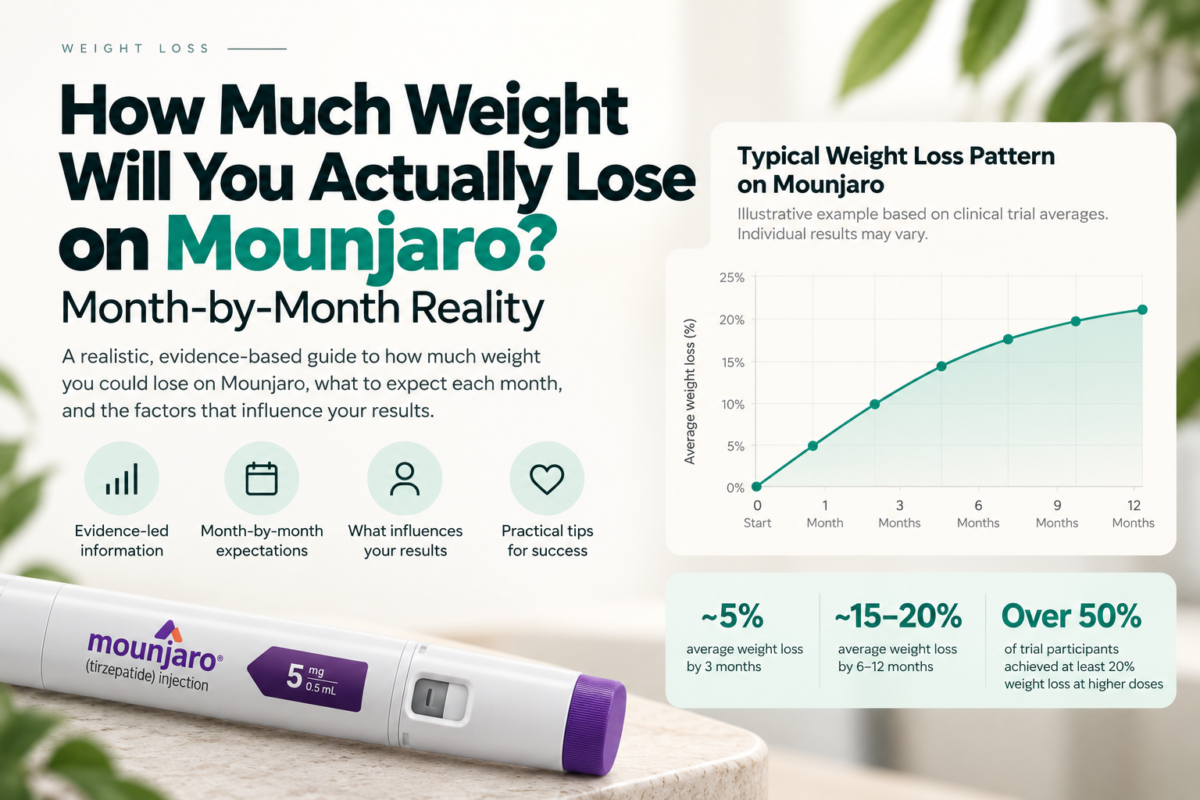
GLP-1 receptor agonists such as semaglutide (Wegovy) and tirzepatide (Mounjaro) have transformed weight loss treatment in the UK, and they are increasingly being discussed in the context of long-term maintenance as well.
The rationale is straightforward: if obesity has significant biological drivers, including genetic predisposition, hormonal regulation, and metabolic adaptation, then ongoing pharmacological support may be appropriate for some people, just as ongoing medication is appropriate for chronic conditions like hypertension or type 2 diabetes.
Research supports this view. Studies on both semaglutide and tirzepatide show that patients who continue medication maintain their weight loss, while those who stop tend to regain a substantial portion. This does not mean lifelong medication is the right answer for everyone, but it does mean it should be part of the conversation about maintenance options.
For some patients, a lower “maintenance dose” of medication may provide sufficient appetite management to prevent regain while minimising side effects and cost. For others, medication may be most useful as a temporary tool during particularly vulnerable periods, such as during high stress or after a period of regain.
Looking for Support with Long-Term Weight Management?
Evernu provides clinician-led weight loss treatment with ongoing support for patients across England, Scotland, Wales, and Northern Ireland. Our team can help you develop a sustainable plan that extends beyond initial weight loss into long-term maintenance.
Explore our weight loss treatments or take our free eligibility questionnaire.
Even Partial Maintenance Has Real Value
One of the most important and underappreciated findings in weight management research is that you do not need to maintain 100 percent of your weight loss to gain significant health benefits.
Research from the UK National Institute for Health and Care Excellence (NICE) and multiple other bodies has consistently shown that even a sustained 5 to 10 percent reduction in body weight produces clinically meaningful improvements in:
- Blood sugar control and reduced risk of type 2 diabetes progression
- Blood pressure reduction
- Cholesterol levels, particularly improvements in the ratio of HDL to LDL cholesterol
- Cardiovascular risk markers
- Joint pain and mobility, particularly for weight-bearing joints
- Sleep quality, including reduced severity of obstructive sleep apnoea
- Mental health, including reduced symptoms of depression and improved self-esteem
This means that if you lose 20kg and regain 10kg, you have still achieved a 10kg net loss that is delivering real, measurable health benefits. That is not a failure. It is a meaningful achievement that deserves recognition.
The tendency to frame anything less than total maintenance as failure is not just inaccurate, it is actively harmful. It discourages people from trying and devalues the genuine progress they have made. A more honest and helpful perspective is to view weight maintenance as a spectrum, where any sustained loss is better than none, and where the goal is to protect as much of your investment as possible.
Practical Steps You Can Take Today
If you are currently in the weight loss phase and looking ahead to maintenance, or if you have already reached your goal and want to protect your progress, here are concrete actions you can take:
- Start building maintenance habits now. Do not wait until you have reached your target weight. Begin establishing the exercise routine, eating patterns, and coping strategies that you will rely on during maintenance while you still have the momentum and structure of active weight loss.
- Set a ceiling weight. Choose a number, perhaps three to four kilograms above your target, that will trigger you to take active steps if reached. This provides an early warning system and prevents the gradual, almost imperceptible regain that catches many people off guard.
- Identify your vulnerable situations. Think about the specific circumstances in which you tend to overeat: stress, boredom, social events, evenings alone. Develop specific plans for each one. The more concrete your plan, the more likely you are to follow it.
- Find your support system. This might be a partner, a friend on a similar journey, an online community, or a healthcare professional. Weight maintenance is significantly easier with accountability and encouragement than without it.
- Redefine success. Shift your measure of success from the scale to the behaviours. Did you eat well most days this week? Did you exercise? Did you manage stress without resorting to food? These are the leading indicators that predict long-term outcomes.
The Honest Answer
Is it possible to maintain weight loss? Yes, it genuinely is. But it requires acknowledging that maintenance is not a passive state. It is an active, ongoing practice that demands attention, planning, and flexibility.
The biology working against you is real, but it is not destiny. The psychological challenges are significant, but they are manageable. The statistics are daunting, but they represent averages, not inevitabilities.
People who maintain weight loss long-term are not fundamentally different from those who do not. They have simply learned to do a few key things consistently: stay active, monitor their weight, manage stress without food, treat setbacks as temporary, and seek support when they need it. These are learnable skills, not innate traits.
The journey does not end when you reach your target weight. In many ways, that is where the most important part begins.
Frequently Asked Questions
What percentage of people successfully maintain weight loss long-term?
Research suggests that approximately 15 to 20 percent of people who lose significant weight maintain that loss for at least one year. The percentage decreases somewhat over longer timeframes, but studies of long-term maintainers show that those who maintain for two to five years have a significantly higher probability of keeping the weight off permanently. The key factors associated with success include regular physical activity, self-monitoring, and having a structured maintenance plan.
Why does my body seem to want to return to my previous weight?
Your body has several mechanisms designed to resist weight loss and promote weight regain, likely evolved as protection against famine. These include increased appetite hormones that make you feel hungrier, reduced metabolic rate so you burn fewer calories, and changes in how your brain responds to food cues. These changes can persist for months to years after weight loss. While they make maintenance more challenging, they can be managed through the strategies outlined in this article.
How long do I need to maintain my weight before it becomes “permanent”?
There is no clear point at which maintenance becomes permanent, and framing it that way can be counterproductive. However, research suggests that the risk of regain decreases significantly after two to five years of successful maintenance. This is partly because the physiological adaptations that promote regain appear to diminish over time, and partly because maintenance behaviours become increasingly habitual. That said, lifelong awareness and ongoing healthy habits remain important regardless of how long you have maintained your weight.
Does it matter how I lost the weight when it comes to maintenance?
The method of weight loss does influence maintenance to some degree. People who lose weight very rapidly, through extreme diets or very low calorie plans, tend to have higher regain rates than those who lose weight more gradually. However, the most important factor is not how the weight was lost but what maintenance strategies are adopted afterwards. Whether you lost weight through lifestyle changes, medication, or a combination, the principles of maintenance are the same: sustained physical activity, mindful eating, self-monitoring, and psychological resilience.
Can weight loss medications help with long-term maintenance?
Yes. Clinical evidence shows that GLP-1 receptor agonists such as semaglutide and tirzepatide can support long-term weight maintenance when continued after the weight loss phase. The decision to use medication for maintenance should be made in consultation with your healthcare provider, taking into account your individual circumstances, risk factors, and preferences. For some people, ongoing medication is an appropriate and evidence-based component of a comprehensive maintenance strategy.