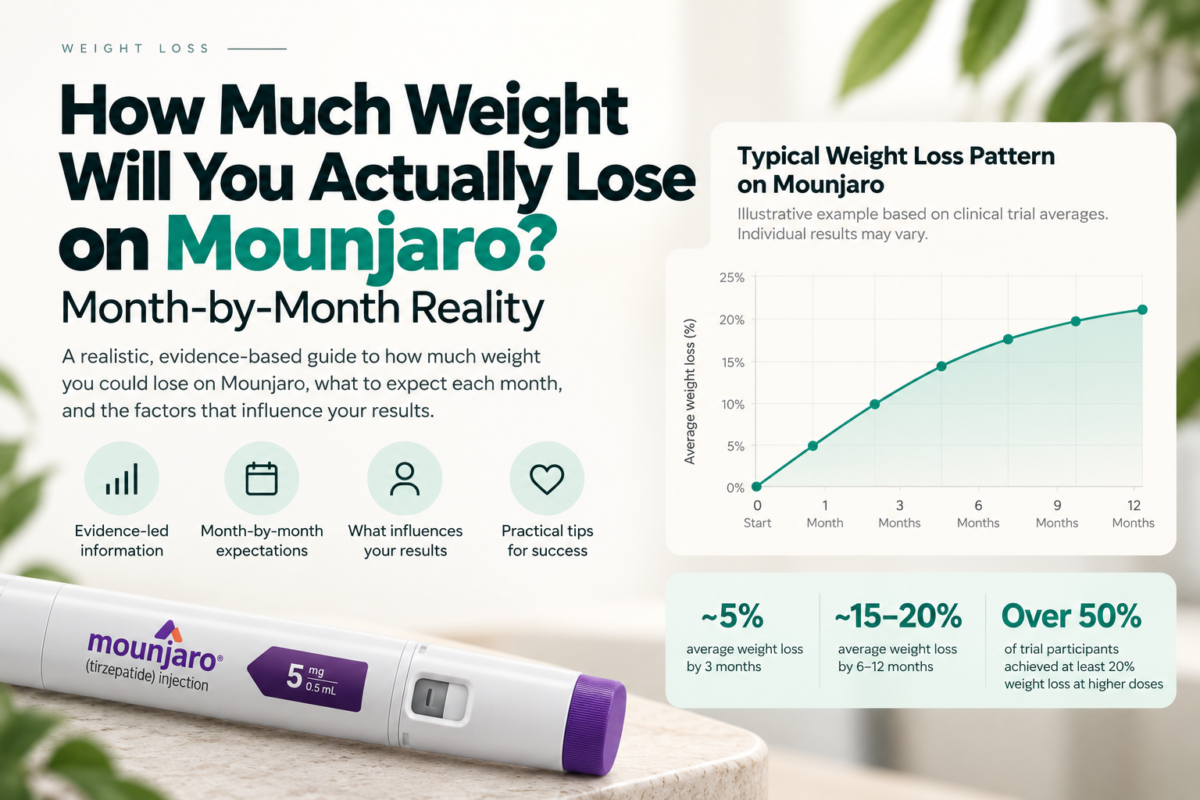
If you have spent any time in weight loss forums or social media groups, you have probably come across the term “golden dose” in relation to Mounjaro. It is one of the most searched-for topics among people using tirzepatide for weight loss. But there is a lot of confusion about what it actually means — and getting it wrong could put your health at risk.
The term “golden dose” actually refers to two completely different things, and this article covers both: the leftover liquid in the Mounjaro pen (the original meaning) and the concept of finding your personal optimal dose (how many people now use the term). Understanding both is important for your safety and your results.
The Original Meaning: The “5th Dose” in the Mounjaro Pen
The Mounjaro KwikPen is designed to deliver four pre-measured doses. Each pen contains slightly more liquid than the four doses require, because a small overfill is needed to account for the initial flow check (priming) and to ensure every dose is complete.
After using all four prescribed doses, some users noticed that a small amount of liquid remained in the pen. This leftover liquid became known as the “golden dose” or “5th dose” in online communities. Users began sharing tips on how to extract and inject this remaining liquid to get an extra dose from each pen — essentially stretching their supply.
Why You Should NOT Use the Golden Dose
While the temptation to get a free extra dose is understandable — especially given the cost of Mounjaro — using the leftover liquid is unsafe for several important reasons:
- Inaccurate dosing: The remaining liquid is not a pre-measured amount. It varies from pen to pen and depends on factors like how the flow check was performed. You have no way of knowing exactly how much tirzepatide you are injecting, which could mean too little (ineffective) or too much (increased side effects).
- Bacterial contamination: Each Mounjaro pen is designed for single-use over its prescribed four doses. The pen’s seal and sterility are not guaranteed beyond this. Reusing a pen that has already been punctured multiple times increases the risk of bacterial contamination.
- No needle available: The pen is designed to be used with its integrated needle mechanism for four doses. Attempting to extract remaining liquid typically requires separate syringes, which introduces additional contamination and dosing accuracy risks.
- Manufacturer warning: Eli Lilly, the manufacturer of Mounjaro, explicitly states that the pen is not designed to provide a fifth dose. The overfill is a manufacturing standard to ensure the four prescribed doses are complete, not to provide bonus medication.
- Potential side effects: An inaccurate dose — whether too high or too low — can cause unpredictable side effects. Too much tirzepatide at once can lead to severe nausea, vomiting, and other gastrointestinal problems.
Safety Warning: Do not attempt to use leftover liquid from your Mounjaro pen. Dispose of used pens according to your pharmacist’s instructions. If you are struggling with the cost of Mounjaro, speak to your prescribing clinician about options.
The Second Meaning: Finding Your Optimal Mounjaro Dose
More recently, the term “golden dose” has been adopted by many people to mean something different: the specific dose of Mounjaro where you personally experience the best results — strong appetite suppression, steady weight loss, and manageable side effects. This is sometimes also called the “sweet spot” dose.
This is a valid concept, even if the terminology has evolved from its original meaning. Every person responds differently to tirzepatide, and finding the dose that works best for you is an important part of the treatment process.
Mounjaro Dose Levels
Mounjaro (tirzepatide) is available in six dose strengths:
- 2.5mg — Starting dose (first 4 weeks)
- 5mg — First escalation
- 7.5mg — Second escalation
- 10mg — Mid-range dose
- 12.5mg — Higher dose
- 15mg — Maximum dose
The standard protocol involves starting at 2.5mg for four weeks, then increasing to 5mg, and continuing to escalate every four weeks until you reach a dose that produces adequate weight loss. For some people, that might be 5mg. For others, it might be 12.5mg or the full 15mg.
Why Everyone’s Optimal Dose Is Different
Several factors influence which dose works best for you:
- Body weight and composition: Larger bodies generally require higher doses to reach the same blood concentration of tirzepatide.
- Metabolic factors: How your body processes the medication varies based on liver function, kidney function, and genetic differences in drug metabolism.
- Baseline appetite: If your hunger hormones are severely dysregulated, you may need a higher dose for meaningful appetite suppression.
- GLP-1 receptor sensitivity: Some people are highly responsive to even small doses, while others are naturally more resistant.
- Previous GLP-1 use: If you have previously used semaglutide (Ozempic or Wegovy), your receptors may have some desensitisation.
How to Find Your Optimal Dose
Finding the right dose should be a collaborative process with your clinician, not something you decide based on online advice:
1. Start at 2.5mg and observe
The starting dose is primarily for tolerability, not weight loss. Use this month to see how your body responds. Some people do experience appetite suppression even at 2.5mg — if you are losing weight steadily, there is no requirement to increase.
2. Escalate gradually and assess at each level
At each new dose, give yourself at least four weeks before deciding whether to escalate. It takes two to three weeks for tirzepatide to reach steady-state concentration at a new dose. At each level, ask yourself:
- Is my appetite noticeably reduced between meals?
- Am I eating less without having to force it?
- Am I losing weight at a rate of 0.5–1kg per week?
- Are side effects manageable?
If the answer to all four is yes, you may have found your optimal dose.
3. Do not chase a higher number
One of the most common mistakes is thinking that a higher dose automatically means better results. Clinical trials show that the difference between doses is often smaller than people expect. The jump from 10mg to 15mg, for example, produced only modest additional weight loss in the SURMOUNT trials, while significantly increasing gastrointestinal side effects.
4. Factor in your lifestyle
Your optimal dose is influenced by what you do alongside the medication:
- Protein intake: Consuming 1.2–1.6g per kilogram of body weight daily preserves lean muscle and supports metabolism.
- Resistance training: Lifting weights 2–3 times per week sends signals to maintain muscle tissue.
- Hydration: 2–2.5 litres daily supports the medication’s function and helps manage side effects.
- Sleep: Poor sleep disrupts hunger hormones and can counteract appetite suppression.
At Evernu, our weight loss programme combines Mounjaro with structured guidance on all of these factors. Many patients find that with proper nutrition and exercise support, they achieve excellent results at lower doses — which means fewer side effects and lower cost.
Common Optimal Dose Patterns
Based on clinical experience and published trial data:
- Low-dose responders (2.5mg–5mg): Approximately 15–20% of patients. These individuals tend to have strong receptor sensitivity or mild appetite dysregulation.
- Mid-dose responders (7.5mg–10mg): The majority — roughly 50–60%. This range is where most people experience strong appetite suppression with manageable side effects.
- High-dose responders (12.5mg–15mg): Around 20–30%. More common in people with higher starting weights or previous GLP-1 use.
Your Optimal Dose Can Change
An important consideration: your best dose can shift over time.
- Dose fatigue: Some patients experience a gradual reduction in appetite suppression at a given dose after several months. A dose increase may restore effectiveness.
- Weight loss plateau: As you lose weight, your body’s energy requirements decrease. A dose that produced good results at 95kg may be less effective at 80kg.
- Maintenance phase: Once you reach your target weight, some patients can decrease their dose while maintaining results.
The Role of Your Clinician
Whether we are talking about the leftover pen liquid or finding your optimal dose level, the message is the same: work with your clinician, not the internet.
Do not attempt to use leftover liquid from your Mounjaro pen. And do not escalate or change your dose based on what worked for someone in a Facebook group. Your clinician can assess your progress objectively, distinguish between normal adaptation and genuine lack of response, and make safe dosing decisions.
At Evernu, our clinicians conduct mid-cycle check-ins with every patient, reviewing weight trends, side effects, and overall wellbeing before making any dose change recommendations. This structured approach helps patients find their optimal dose safely and with fewer problems along the way.
Key Takeaways
- The “golden dose” originally refers to leftover liquid in the Mounjaro pen after 4 doses — do not use it
- The pen overfill is a manufacturing standard, not a bonus dose
- Using leftover liquid risks inaccurate dosing, contamination, and unpredictable side effects
- The term has also come to mean your personal optimal dose level
- Most patients find their optimal dose between 7.5mg and 10mg
- Higher doses are not automatically better — they come with more side effects
- Give each dose at least 4 weeks before escalating
- Protein, exercise, hydration, and sleep all influence how effective any dose is
- Work with your clinician rather than following online dosing advice
Ready to take the next step?
Take the first step towards better health. Our quick assessment connects you with the right treatment plan, tailored to your unique needs.
Get Started Now