One of the most common questions patients ask after starting Mounjaro (tirzepatide) is: when should I increase my dose? It is a fair question, and the answer is more nuanced than simply following a fixed schedule. Getting the dose escalation right can mean the difference between steady, sustainable weight loss and a frustrating experience of side effects without adequate results.
This guide explains the Mounjaro dose escalation schedule, the clinical reasoning behind it, how to recognise when you should increase your dose, and — just as importantly — when you should stay where you are.
The Mounjaro Dose Escalation Schedule
Mounjaro is available in six dose strengths, each delivered as a weekly subcutaneous injection:
- 2.5 mg — Starting dose (titration)
- 5 mg — First therapeutic dose
- 7.5 mg — Intermediate dose
- 10 mg — Higher therapeutic dose
- 12.5 mg — Advanced dose
- 15 mg — Maximum dose
The standard protocol, as outlined in the Summary of Product Characteristics (SmPC), is to begin at 2.5 mg and increase by one dose level every four weeks. However, this schedule is a guideline, not a rigid rule. In clinical practice, the decision to increase, stay, or even reduce a dose should be individualised based on your response, tolerability, and goals.
Understanding the Purpose of Each Dose Level
Not every dose of Mounjaro serves the same purpose. Understanding what each level is designed to do helps explain why the escalation exists and why patience at certain stages is important.
2.5 mg: The Acclimatisation Dose
The 2.5 mg dose is explicitly a titration dose. It is not expected to produce significant weight loss. Its purpose is to allow your gastrointestinal system to adjust to tirzepatide’s effects on gastric emptying, insulin secretion, and appetite signalling.
During this phase, you may notice mild appetite suppression, some nausea or bloating, and perhaps a kilogram or two of weight change. Equally, you may notice very little at all. Both are normal.
Many patients ask: can I stay on 2.5 mg Mounjaro for weight loss? Technically, you can stay on any dose your prescriber is comfortable with. But 2.5 mg is unlikely to produce meaningful or sustained weight loss for most people. The clinical trials that demonstrated Mounjaro’s effectiveness did not include a 2.5 mg treatment arm for this reason — it is a stepping stone, not a destination.
5 mg: The First Therapeutic Dose
At 5 mg, you begin to experience the therapeutic effects of tirzepatide. Appetite suppression becomes more noticeable and consistent, food noise decreases, and most patients begin to see measurable weight loss within two to four weeks of reaching this dose.
For some patients, 5 mg is sufficient. If you are losing weight steadily (0.5–1 kg per week), side effects are manageable, and your appetite is well controlled, there is no obligation to increase further. The best dose is the lowest effective dose — the one that produces results with tolerable side effects.
However, for many patients, the appetite-suppressing effects of 5 mg begin to diminish after six to eight weeks as the body adapts. This is a sign that a dose increase may be appropriate.
7.5 mg: The Intermediate Step
The 7.5 mg dose was introduced specifically to provide a more gradual escalation path. Before it was available, patients jumped directly from 5 mg to 10 mg, which caused a significant spike in gastrointestinal side effects for some people.
At 7.5 mg, appetite suppression is notably stronger than at 5 mg, and many patients find this to be their “sweet spot” — the dose where appetite is well controlled, weight loss is steady, and side effects are minimal.
10 mg: The Higher Therapeutic Dose
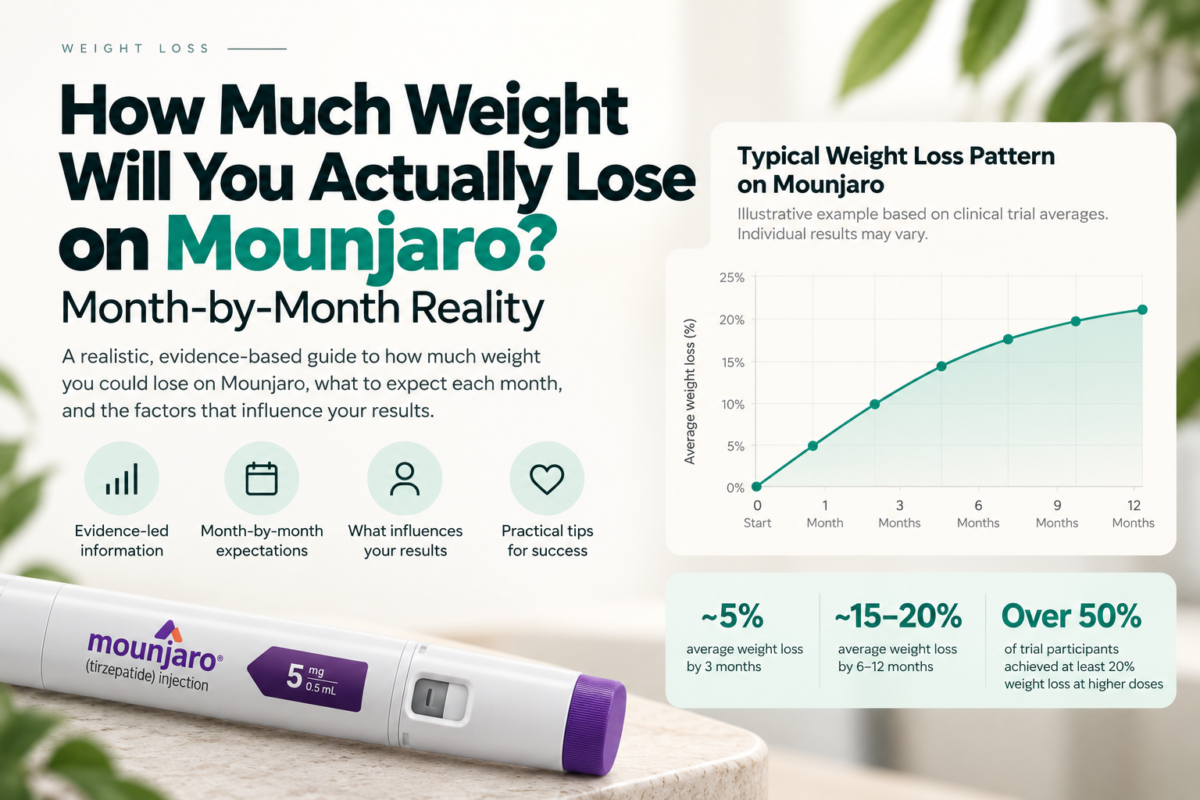
The 10 mg dose was one of the primary treatment doses in the SURMOUNT-1 clinical trial. Participants on 10 mg lost an average of approximately 20% of their body weight over 72 weeks. At this dose, appetite suppression is strong, and most patients report a fundamentally different relationship with food.
Side effects at 10 mg can include nausea, constipation, diarrhoea, and reduced appetite to the point where eating enough becomes a deliberate effort. This is why adequate protein intake matters so much at higher doses — if your appetite is very suppressed, every meal needs to count nutritionally.
12.5 mg and 15 mg: The Maximum Doses
These doses provide the strongest appetite suppression and were associated with the highest average weight loss in clinical trials (up to 22.5% of body weight on 15 mg in SURMOUNT-1). However, they also carry the highest rates of gastrointestinal side effects.
Not every patient needs to reach these doses. If 7.5 mg or 10 mg is producing satisfactory results with acceptable side effects, there is no clinical reason to escalate further. Higher doses mean more drug exposure, more potential for side effects, and higher cost — without guaranteed proportional benefit.
Signs You Should Increase Your Mounjaro Dose
The decision to increase your dose should be based on a careful assessment of your response, not simply on the passage of four weeks. Here are the signs that suggest a dose increase may be appropriate:
1. Your Appetite Suppression Has Faded
This is the most reliable indicator. When you first moved to your current dose, you probably noticed a distinct reduction in appetite — less interest in food, earlier fullness at meals, reduced food noise between meals. If these effects have gradually diminished over the past two to three weeks, and you are finding yourself hungrier than you were shortly after starting the dose, it may be time to move up.
2. Weight Loss Has Stalled for Three or More Weeks
A one-week plateau is normal. A two-week plateau can happen. But if the scales have not moved at all for three consecutive weeks — and you are confident that your diet, exercise, sleep, and protein intake have remained consistent — a dose increase is worth discussing.
Important caveat: make sure the stall is genuine and not caused by one of the other factors discussed in the article above. Calorie creep, reduced exercise, poor sleep, or inadequate protein can all cause a plateau that has nothing to do with dose.
3. You Have Been on the Current Dose for at Least Four Weeks
The four-week rule exists for good reason. It takes approximately two to three weeks for tirzepatide to reach steady-state blood levels at a new dose, and another week or so to fully assess the impact on appetite and weight. Increasing before four weeks means you may not have given the current dose a fair trial.
4. Your Side Effects Have Settled
If you are still experiencing significant nausea, vomiting, or gastrointestinal discomfort on your current dose, increasing is likely to make those symptoms worse. Only consider a dose increase when side effects from the current dose have become manageable or have resolved.
5. You Are Not Meeting Your Clinical Goals
Your prescriber will have discussed weight loss targets with you based on your starting weight, health conditions, and personal goals. If you are not on track to meet those goals at your current dose — even after accounting for realistic timelines — a dose increase may be warranted.
Signs You Should Stay on Your Current Dose
Not every review should result in a dose increase. Here are clear reasons to stay where you are:
1. You Are Still Losing Weight
If you are losing 0.5 to 1 kg per week consistently, there is no reason to increase the dose. This rate of weight loss is clinically optimal — fast enough to produce meaningful results, slow enough to preserve muscle mass and allow your skin and body to adapt.
Some patients feel pressure to increase because they see others on social media losing weight faster. Resist this impulse. Faster is not always better, and a lower effective dose means fewer side effects, lower cost, and more room to escalate if needed later.
2. Your Appetite Is Well Controlled
If you rarely feel hungry between meals, are satisfied with smaller portions, and food noise is minimal, your current dose is doing its job. Increasing would not necessarily improve your results but could introduce or worsen side effects.
3. Side Effects Are Still Significant
If you are still experiencing nausea, constipation, bloating, or other gastrointestinal side effects on your current dose, give your body more time to adjust before moving up. There is no benefit to increasing a dose that you are not yet tolerating well.
In fact, staying on a dose for six or even eight weeks, rather than the standard four, is perfectly acceptable and sometimes preferable. The four-week minimum is exactly that — a minimum, not a mandatory escalation point.
4. You Are Happy with Your Rate of Progress
This is ultimately about your individual goals and quality of life. If you are losing weight at a pace you are comfortable with, side effects are minimal, and you feel good, staying on a lower dose may be the right choice for you — even if the standard protocol suggests moving up.
Why Do You Have to Increase the Mounjaro Dose?
A common question is why increasing is necessary at all. If 5 mg was working well in weeks five and six, why does it sometimes stop working by weeks ten or twelve?
The answer involves a concept called tachyphylaxis (or drug tolerance). Over time, the body’s receptors can become somewhat desensitised to a consistent level of GLP-1 and GIP stimulation. The same dose that initially produced strong appetite suppression may produce a weaker effect after several weeks of continuous exposure.
This does not happen to everyone — some patients find a dose that works and stay on it for months without any reduction in effectiveness. But for many, periodic dose increases are needed to maintain the level of appetite suppression required for continued weight loss.
Other contributing factors include:
- Metabolic adaptation: As you lose weight, your body requires fewer calories. A calorie intake that produced a deficit at 100 kg may be closer to maintenance at 85 kg.
- Reduced body mass: At a lower body weight, the same dose of medication produces a proportionally higher blood concentration. But the receptors may still require more stimulation to maintain the same level of appetite suppression.
- Psychological adaptation: Over time, the novelty of reduced appetite wears off, and old eating habits can gradually reassert themselves. A dose increase resets the appetite suppression and makes it easier to maintain healthier eating patterns.
What Happens at Each Dose Level: Typical Experiences
While individual responses vary, here is what many patients in the UK report at each dose level. These are generalisations based on clinical experience and patient feedback, not guarantees of your personal experience.
2.5 mg (Weeks 1–4)
- Mild appetite reduction — some patients notice very little
- Possible mild nausea, particularly after eating large or fatty meals
- Minimal weight change (0–2 kg)
- Some patients feel nothing at this dose
5 mg (Weeks 5–8)
- Noticeable appetite suppression — eating less without effort
- Food noise begins to reduce
- Weight loss typically begins (1–3 kg over four weeks)
- Nausea may increase briefly before settling
- Some patients experience constipation or changes in bowel habits
7.5 mg (Weeks 9–12)
- Stronger appetite control — may need reminders to eat
- More consistent weight loss (1.5–3 kg over four weeks)
- Clothes begin fitting differently
- Energy levels often improve
- Gastrointestinal side effects vary — some patients find them manageable, others more challenging
10 mg (Weeks 13–16)
- Strong appetite suppression — eating becomes a deliberate activity rather than a response to hunger
- Continued weight loss, though the rate may slow as you approach a lower body weight
- Food preferences may shift — reduced interest in high-calorie foods
- Protein intake requires conscious effort due to low appetite
12.5 mg and 15 mg (Weeks 17+)
- Maximum appetite suppression
- Continued but often slower weight loss (closer to goal weight)
- Gastrointestinal side effects are more common at these doses
- Not everyone needs or benefits from these doses
Can You Skip Doses in the Escalation Schedule?
Generally, no. Jumping from 2.5 mg directly to 10 mg, for example, significantly increases the risk of severe nausea, vomiting, and other gastrointestinal side effects. The gradual escalation exists specifically to minimise these risks.
However, some prescribers may recommend a slightly faster escalation in specific clinical situations — for instance, if a patient has been on semaglutide (Wegovy or Ozempic) and is switching to tirzepatide, their gastrointestinal system may already be adapted to GLP-1 stimulation, allowing a faster titration. This is always a clinical decision, not something to do unilaterally.
Can You Reduce Your Dose?
Yes, and sometimes this is the right decision. If side effects at a higher dose are significantly affecting your quality of life — persistent nausea, vomiting, inability to eat enough — stepping back down to the previous dose is a sensible option. You were losing weight at that dose, after all; the higher dose was an attempt to accelerate results, not a one-way ticket.
Some patients find their long-term “sweet spot” at a dose lower than the maximum. A patient who loses weight steadily on 7.5 mg with minimal side effects may be better served staying there than pushing to 10 mg or higher, where side effects might compromise their ability to eat adequate protein and exercise consistently.
The Evernu Approach: Clinician-Guided Dose Management
At Evernu, dose management is a collaborative process between you and your clinical team. We do not follow a one-size-fits-all escalation schedule. Instead, we assess your response at each dose level based on:
- Your rate of weight loss
- Your appetite control and food noise levels
- Any side effects you are experiencing
- Your protein intake and exercise adherence
- Your overall wellbeing and quality of life
Our mid-cycle check-ins are specifically designed to monitor these factors and make dose adjustments based on evidence, not assumptions. If a dose is working, we keep you there. If it is not, we investigate why before automatically escalating — because sometimes the solution is a dietary adjustment or a change in exercise routine, not a higher dose of medication.
We believe the best dose is the lowest dose that produces consistent results with tolerable side effects. This approach minimises unnecessary drug exposure, reduces side effect burden, and keeps higher doses available as a tool for later in your journey if needed.
Key Takeaways
- Mounjaro dose escalation follows a schedule starting at 2.5 mg and increasing every four weeks, but it should be individualised to your response
- The 2.5 mg dose is for acclimatisation only — do not expect significant weight loss at this level
- Signs to increase include fading appetite suppression, a genuine three-week weight loss stall, and manageable or resolved side effects
- Signs to stay include ongoing weight loss, good appetite control, and persistent side effects that have not yet settled
- The best dose is the lowest effective dose that produces results with tolerable side effects
- You can reduce your dose if side effects are too significant — stepping back is not failure
- Dose tolerance (tachyphylaxis) is a normal process that sometimes necessitates increases
- Never skip dose levels without clinical guidance, as this increases side effect risk
- Work with your prescriber to make dose decisions based on your individual response, not social media comparisons