Mounjaro: When Does It Start Working and What Should You Expect?
Starting a new weight loss medication brings a lot of questions. Chief among them: when will I actually see results?
It’s a fair thing to want to know upfront. Mounjaro (tirzepatide) is now one of the most prescribed weight loss injections in Northern Ireland, and for good reason — but it doesn’t work overnight. Understanding what to expect at each stage makes the whole process far less frustrating, and helps you stay on track when progress feels slower than you’d like.
This guide breaks down how tirzepatide works in the body, what a realistic journey looks like week by week, and how it compares to other weight loss injections available in Northern Ireland, including semaglutide-based treatments like Wegovy. Evernu prescribes and dispenses Mounjaro online to patients across Northern Ireland — no clinic visit required.
How Tirzepatide Works in the Body
Unlike older weight loss medication, Mounjaro is a dual-receptor agonist. It activates both GLP-1 (glucagon-like peptide-1) and GIP (glucose-dependent insulinotropic polypeptide) pathways simultaneously — something no other licensed weight loss injection currently does.
In practical terms, this combination does several things at once. It tells your brain you’re satisfied sooner, slows the rate at which food leaves your stomach, reduces background hunger between meals, and improves how your body handles blood sugar. The result is that eating less becomes considerably easier — not through willpower, but through a genuine shift in how hunger signals operate.
Who qualifies for Mounjaro? In Northern Ireland, tirzepatide is prescribed for adults who have:
A BMI of 30 or above
A BMI of 27–29.9 alongside a condition linked to excess weight, such as hypertension or type 2 diabetes
It’s worth noting that improvements to blood sugar regulation often appear before significant weight loss does. If the scale isn’t shifting in the early weeks but you feel noticeably less hungry, that’s the medication doing exactly what it’s supposed to do.
A Realistic Week-by-Week Breakdown
Everyone’s body responds slightly differently to tirzepatide, but clinical data and patient experience tend to follow a recognisable pattern. Here’s what that typically looks like.
The First Two Weeks (2.5mg)
The starting dose for all patients is 2.5mg, regardless of previous experience with GLP-1 medications. This low dose is intentional — it gives your digestive system time to adapt before the dose increases.
During this phase, don’t expect dramatic changes on the scale. What you’re more likely to notice is a quietening of appetite. Portions that previously felt normal start to feel like too much. The urge to snack in the evening becomes less insistent. These are early signs that the medication is active and working as intended.
Some patients experience nausea, loose stools, or mild stomach discomfort in the first week. This generally passes as the body adjusts. Eating smaller meals, avoiding high-fat foods, and keeping well hydrated all help ease these early effects.
Weeks Three and Four
By the end of the first month, most people begin to see their efforts reflected on the scale. Clothes may fit a little differently. The pull towards high-calorie foods tends to feel less powerful.
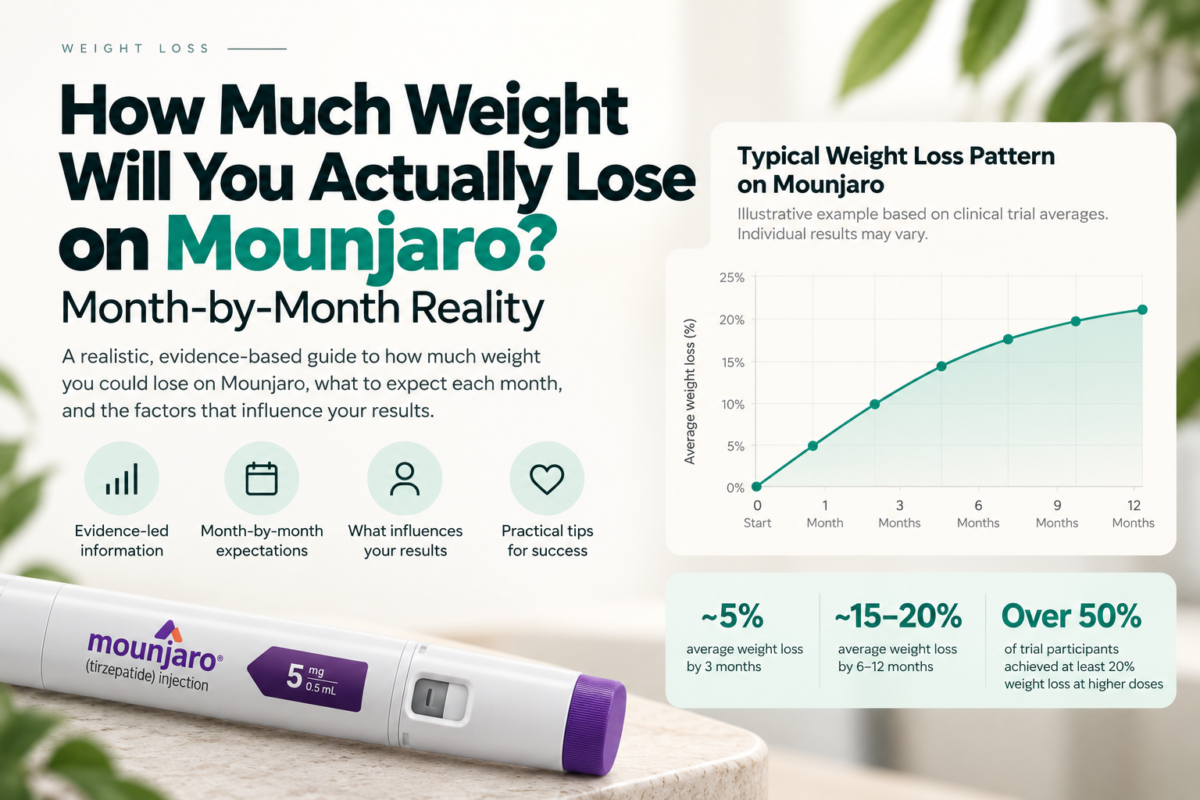
Clinical trial data published in the New England Journal of Medicine (Jastreboff et al., 2022) recorded average weight reductions of 2–4% of total body weight by the four-week mark. That might sound modest, but for someone weighing 100kg, that’s already 2–4kg — often without the hunger and restriction that typically accompany dieting. Prioritising protein and fibre at this stage helps maintain energy and keeps progress steady.
Weeks Five to Eight
This is where things tend to pick up. Dose increases may begin during this window, and with them, a stronger appetite-suppressing effect. Hunger becomes more predictable. The tendency to overeat at trigger situations — social meals, stress, boredom — starts to diminish.
Trial data indicates cumulative weight loss of roughly 5–6% of starting body weight by week eight. Alongside the number on the scale, tracking waist measurements gives a broader picture of how body composition is changing — fat loss around the abdomen often precedes broader scale movement.
Weeks Nine to Twelve
Around the nine-week point, many patients move to the 7.5mg dose. As with every dose step-up, mild nausea or digestive discomfort can reappear briefly. It typically resolves within a week.
By the end of the twelve-week period, clinical participants had lost an average of 9–12% of their original body weight (Jastreboff et al., 2022). Twelve weeks is also a meaningful milestone in another respect — it’s enough time to properly evaluate whether the treatment is the right fit for you.
A note on dose increases: Progressing to a higher dose isn’t mandatory. If results are satisfactory at 5mg, many patients and prescribers agree to maintain that level rather than increasing further. Discuss what works best for your situation with your Evernu clinician.
Beyond Week Thirteen
From the three-month mark onward, doses of 10mg and 15mg become available. The SURMOUNT-1 trial — the landmark tirzepatide study — recorded average weight loss of 20.9% of body weight at the 15mg dose over 72 weeks (Jastreboff et al., 2022). That’s a level of efficacy that exceeds any previously licensed weight loss medication.
At this stage, if cravings for sweet or fatty foods persist, it’s rarely true hunger. It’s more likely a habitual or emotional eating pattern — and that’s worth exploring with your prescriber to make sure your long-term results are protected.
Why Results Vary Between Patients
Two people can follow the same dose schedule, eat similarly, and still lose weight at different rates. Several factors account for this:
Body composition at the start — Patients with a higher starting BMI often see proportionally larger early losses, while those closer to a healthy weight may notice more gradual changes. Neither outcome means the treatment isn’t working.
How doses are titrated — The 2.5mg starter dose isn’t designed to produce major weight loss. It’s a tolerance-building phase. Expecting significant results before reaching a therapeutic dose will lead to unnecessary disappointment.
What you do alongside the medication — Tirzepatide reduces hunger, but it works considerably better when paired with an increase in dietary protein, regular physical activity, adequate sleep, and limited alcohol. These aren’t optional extras — they meaningfully affect the rate and sustainability of weight loss.
Underlying hormonal factors — Conditions including hypothyroidism, polycystic ovary syndrome (PCOS), and insulin resistance can slow progress. Stress and disrupted sleep raise cortisol and ghrelin levels, which work against the medication’s effects. If progress has stalled for several weeks despite dose increases and consistent habits, it’s worth raising this with your prescriber.
Getting More from Your Treatment
A few evidence-backed habits make a notable difference to outcomes on tirzepatide:
Protein at every meal. Protein preserves muscle mass during weight loss and extends the feeling of fullness. Aim for a source — eggs, chicken, fish, legumes, Greek yoghurt — at breakfast, lunch, and dinner.
Resistance exercise. As the scale drops, the body can lose muscle alongside fat. Two to three sessions of weight training or bodyweight exercise per week counteracts this and supports long-term metabolic health.
Consistent hydration. Tirzepatide can blunt thirst signals in some people. Drinking water regularly throughout the day — rather than waiting to feel thirsty — prevents dehydration, which can be mistaken for hunger.
Sleep and stress management. Chronic sleep deprivation elevates hunger hormones regardless of medication. Even small improvements to sleep consistency can make appetite easier to manage.
Mounjaro vs Ozempic in Northern Ireland — What the Evidence Shows
Patients researching weight loss injections in Northern Ireland frequently ask how Mounjaro compares to Ozempic or Wegovy. The honest answer is that the clinical data favours tirzepatide — though both are effective options.
Mounjaro’s dual mechanism (GLP-1 and GIP) gives it a pharmacological advantage over semaglutide, which acts on GLP-1 alone. The SURMOUNT-1 trial demonstrated average weight loss of 20.9% at the 15mg tirzepatide dose over 72 weeks (Jastreboff et al., 2022). The STEP 1 trial — the equivalent landmark study for semaglutide — recorded 14.9% average weight loss at the 2.4mg dose over 68 weeks (Wilding et al., 2021). That’s a meaningful gap.
Real-world data supports the same conclusion. A 2023 study in JAMA Internal Medicine (Patorno et al., 2023) compared outcomes for patients prescribed tirzepatide against those on semaglutide in routine clinical settings. Tirzepatide patients consistently achieved greater weight loss at the three-, six-, and twelve-month marks.
That said, semaglutide has a longer track record, and individual responses vary. Some patients do very well on Wegovy. The right medication is ultimately the one that works for your body and fits your circumstances — and Evernu’s clinicians can help you work through that decision.
Other Weight Loss Medications Available at Evernu
Medication
Active Ingredient
Format
How It Works
Mounjaro
Tirzepatide
Weekly injection
Dual GLP-1 / GIP receptor activation
Wegovy
Semaglutide
Weekly injection
GLP-1 receptor activation
Saxenda
Liraglutide
Daily injection
GLP-1 receptor activation
Orlistat
Orlistat
Oral capsule (with meals)
Blocks dietary fat absorption
Getting Mounjaro in Northern Ireland Through Evernu
Evernu is a fully regulated online clinic and pharmacy. Every prescription is reviewed by a qualified clinician before being dispensed — the same standard of care as an in-person consultation, without the waiting room.
The process is straightforward:
Fill in a detailed health questionnaire from your phone or computer
A prescribing clinician assesses your answers and confirms suitability
Your medication is packaged discreetly and delivered to your home address
Whether you’re looking for Mounjaro, Wegovy, or want guidance on which weight loss medication in Northern Ireland is right for your situation, Evernu can help you start safely and with full clinical support.
Start your consultation at evernu.co.uk today.
Common Questions
Will I feel Mounjaro working straight away? Appetite changes tend to be the first sign — often noticeable within the first week or two. Scale movement typically follows over the weeks after that.
What’s the fastest way to see results? Sticking to your dose schedule consistently, eating adequate protein, and moving regularly will accelerate your progress more than anything else.
How much weight is typical in the first month? Individual results vary, but trial data points to an average of 2–4% of body weight by week four.
Is there a normal amount to lose each week? Not really — early losses are often higher due to fluid changes, then settle into a steadier pace. Your Evernu clinician can help set realistic expectations based on your starting point.
How long do side effects last? Most side effects appear in the days following an injection or a dose increase and ease within a week. If they’re persistent or severe, contact your prescriber.
What happens when I stop? Without ongoing appetite support, hunger typically returns and some weight regain is common. Planning a maintenance strategy before stopping — rather than after — gives you the best chance of holding onto your results.
Conclusion
Mounjaro doesn’t produce overnight results, but what it does produce — when taken consistently and supported by good habits — is clinically significant, sustained weight loss. Appetite suppression tends to arrive early. Meaningful scale changes follow as doses increase over the first three months, with results continuing to build well beyond that.
For anyone in Northern Ireland exploring weight loss medication — whether that’s Mounjaro, Wegovy, or another option — Evernu offers a straightforward, fully supervised path to treatment that you can begin entirely from home.
References
Jastreboff, A. M., Aronne, L. J., Ahmad, N. N., Wharton, S., Connery, L., Alves, B., Kiyosue, A., Zhang, S., Liu, B., Bunck, M. C., & Stefanski, A. (2022). Tirzepatide Once Weekly for the Treatment of Obesity. New England Journal of Medicine, 387(3), 205–216.
Wilding, J. P. H., Batterham, R. L., Calanna, S., Davies, M., Van Gaal, L. F., Lingvay, I., McGowan, B. M., Rosenstock, J., Tran, M. T. D., Wadden, T. A., Wharton, S., Yokote, K., Zeuthen, N., & Kushner, R. F. (2021). Once-Weekly Semaglutide in Adults with Overweight or Obesity. New England Journal of Medicine, 384(11), 989–1002.
Patorno, E., Glynn, R. J., Hernandez-Diaz, S., Schneeweiss, S., Cohen, J. B., & Paik, J. M. (2023). Comparative effectiveness of tirzepatide versus semaglutide for weight loss: A real-world study. JAMA Internal Medicine.
Ready to take the next step?
Take the first step towards better health. Our quick assessment connects you with the right treatment plan, tailored to your unique needs.