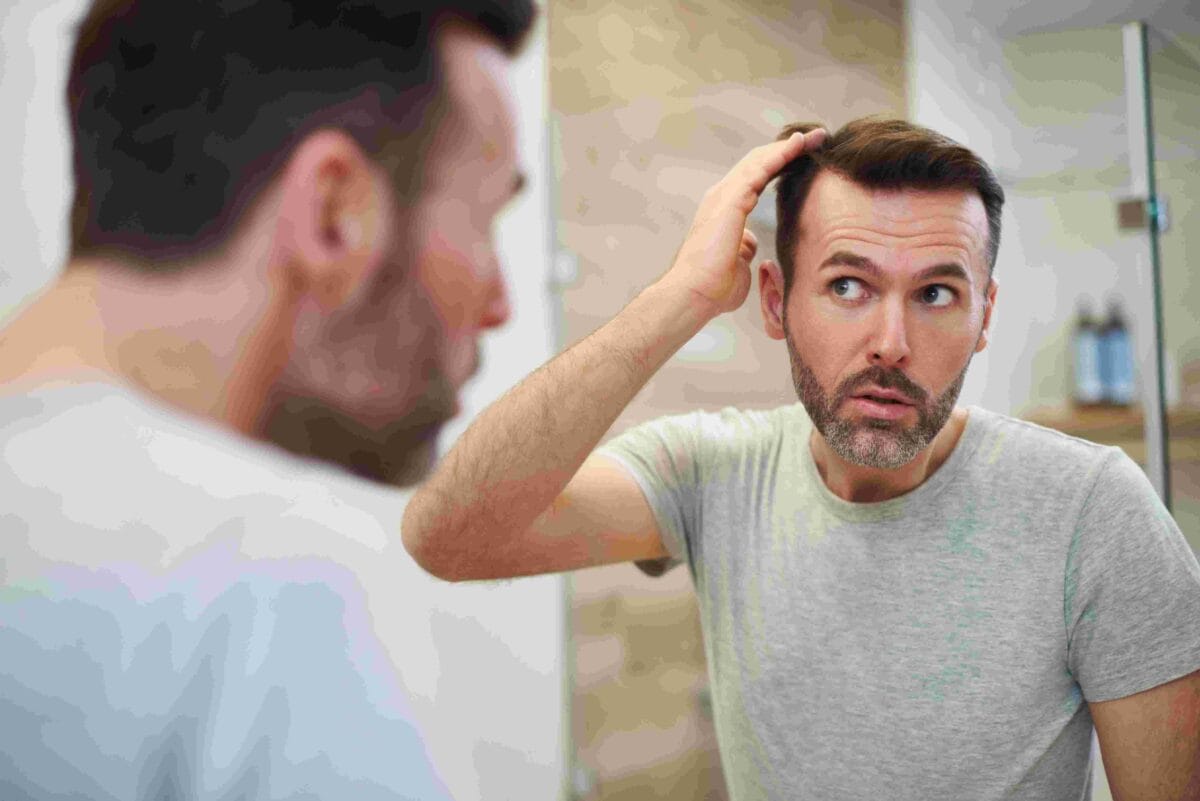
If you’ve noticed your hair thinning — whether it’s a receding hairline, a widening parting, or more scalp visible at the crown — you’ve probably already encountered a bewildering range of advice online. Biotin supplements, special shampoos, scalp massages, rosemary oil. The list of supposed remedies is long, and separating genuine science from marketing can feel like a full-time job.
The truth is that male pattern baldness (androgenetic alopecia) is primarily driven by genetics and hormones, and the treatments that actually work target those underlying mechanisms. That doesn’t mean lifestyle factors are irrelevant — they can play a supporting role — but the foundation of any effective hair regrowth strategy needs to be built on clinical evidence.
In this guide, we break down what genuinely helps hair growth in men, what the research says about each option, and what you can realistically expect from treatment.
Understanding Why Men Lose Hair
Before diving into solutions, it helps to understand what you’re dealing with. Male pattern baldness affects roughly 50% of men over 50 in the UK, according to the NHS. It often begins much earlier — many men notice thinning in their twenties or thirties.
The primary culprit is dihydrotestosterone (DHT), a hormone derived from testosterone. DHT binds to receptors in hair follicles on the scalp, causing them to gradually shrink in a process called follicular miniaturisation. Over time, affected follicles produce progressively thinner and shorter hairs until they eventually stop producing visible hair altogether.
Your genetic sensitivity to DHT determines how severely you’re affected. Two men with identical testosterone levels can have vastly different hair loss patterns depending on how their follicles respond to DHT. This is why some treatments focus on reducing DHT levels or blocking its effects, while others work by stimulating hair growth through different pathways.
Clinically Proven Treatments
These are the treatments with the strongest evidence base — the ones that regulatory bodies including the MHRA and FDA have reviewed and approved based on rigorous clinical trial data.
Finasteride (Propecia)
Finasteride is a prescription-only oral medication that works by inhibiting the enzyme 5-alpha-reductase, which converts testosterone into DHT. By reducing scalp DHT levels by approximately 60-70%, finasteride slows or halts the miniaturisation process and, in many cases, allows weakened follicles to recover.
The clinical evidence for finasteride is extensive. A landmark study published in the Journal of the American Academy of Dermatology found that after two years of treatment, 83% of men taking finasteride 1mg daily maintained or increased their hair count, compared to just 28% of men taking a placebo. After five years of continuous use, 90% of men on finasteride showed no further hair loss progression.
Finasteride is generally most effective at the crown and mid-scalp, though many men also see improvements at the hairline. Results typically become noticeable after three to six months, with optimal outcomes at around 12 months. It is important to understand that finasteride must be taken consistently — stopping treatment allows DHT levels to return to baseline, and hair loss resumes.
Side effects affect a minority of users. The most commonly reported include reduced libido, erectile changes, and decreased ejaculate volume, each occurring in roughly 1-2% of men in clinical trials. These effects are reversible upon discontinuation. For a detailed breakdown, see our guide to finasteride side effects.
If you’re considering finasteride, our complete guide to Propecia and finasteride covers everything you need to know about getting started.
Minoxidil (Regaine)
Minoxidil is an over-the-counter topical treatment available as a liquid (2% or 5%) or foam (5%). Unlike finasteride, minoxidil does not affect hormones. Instead, it works as a vasodilator, improving blood flow to hair follicles and extending the growth (anagen) phase of the hair cycle. It also appears to enlarge miniaturised follicles, allowing them to produce thicker, more visible hairs.
Clinical trials have demonstrated that 5% minoxidil produces statistically significant hair regrowth in approximately 40-60% of men, with the vertex (crown) area typically showing the best response. A meta-analysis in the British Journal of Dermatology confirmed that 5% minoxidil is significantly more effective than the 2% formulation.
Minoxidil must be applied directly to the scalp twice daily (once daily for the foam in some protocols). Results typically appear after three to four months, though an initial shedding phase in the first few weeks is normal and actually indicates that the treatment is working — new hairs are pushing out old, miniaturised ones.
The main drawback is the commitment to daily application. Many men find this inconvenient, and inconsistent use significantly reduces effectiveness. Side effects are generally mild and localised — scalp irritation, dryness, and occasionally unwanted facial hair growth from transfer during sleep. For the full picture, read our guide to minoxidil side effects.
Combining Finasteride and Minoxidil
Because finasteride and minoxidil work through entirely different mechanisms — one blocking DHT production, the other stimulating follicle activity — using them together can produce additive benefits. Several studies have shown that combination therapy produces superior results compared to either treatment alone.
A study in Dermatologic Therapy found that men using both finasteride and minoxidil saw a 94% improvement in hair count at 12 months, compared to 80% with finasteride alone and 59% with minoxidil alone. Many dermatologists now consider combination therapy the gold standard for moderate to advanced male pattern baldness.
Our finasteride vs minoxidil comparison guide can help you decide whether one or both treatments might be right for you.
Emerging and Off-Label Treatments
Beyond the established first-line options, several treatments show promising evidence, even if they haven’t yet received specific hair loss licensing in the UK.
Dutasteride
Dutasteride is a more potent 5-alpha-reductase inhibitor than finasteride. While finasteride blocks only the type II isoform of the enzyme, dutasteride inhibits both type I and type II, reducing DHT levels by approximately 90% — compared to finasteride’s 60-70%.
A head-to-head randomised controlled trial published in the Journal of the American Academy of Dermatology found that dutasteride 0.5mg daily produced significantly greater increases in hair count compared to finasteride 1mg after 24 weeks. While dutasteride is licensed for hair loss in South Korea and Japan, in the UK it is prescribed off-label for this purpose, though it remains MHRA-approved for benign prostatic hyperplasia.
The side effect profile is similar to finasteride, though because of its more comprehensive DHT suppression, some clinicians exercise extra caution when prescribing it. Dutasteride also has a much longer half-life (approximately five weeks versus six to eight hours for finasteride), which is relevant if side effects do occur. Learn more in our comprehensive dutasteride guide.
Research into topical dutasteride is also gaining traction, with early studies suggesting it may offer similar scalp-level DHT reduction with fewer systemic effects.
Low-Level Laser Therapy (LLLT)
Low-level laser therapy uses red light at specific wavelengths (typically 650-670nm) to stimulate cellular activity in hair follicles. Devices are available as laser combs, helmets, and caps designed for home use.
The evidence is moderate but growing. A 2014 randomised controlled trial published in the American Journal of Clinical Dermatology found that men using an LLLT device showed significantly increased hair density after 26 weeks compared to a sham device. A subsequent meta-analysis confirmed a positive effect across multiple trials, though the magnitude of improvement was generally modest compared to pharmaceutical treatments.
LLLT is best viewed as a complementary treatment rather than a standalone solution. It has an excellent safety profile with virtually no side effects, making it a reasonable addition to a regimen that already includes finasteride and/or minoxidil.
Platelet-Rich Plasma (PRP)
PRP therapy involves drawing a small amount of the patient’s blood, concentrating the platelets and growth factors through centrifugation, and injecting the resulting plasma directly into the scalp. The growth factors are believed to stimulate dormant follicles and extend the anagen phase of the hair cycle.
Evidence for PRP is promising but not yet definitive. A systematic review in the Journal of Cosmetic Dermatology found that most studies reported improvements in hair density and thickness after PRP treatment. However, study quality varies, protocols differ significantly between providers, and there are no standardised treatment guidelines.
PRP requires multiple sessions (typically three to four initial treatments spaced four to six weeks apart, followed by maintenance sessions) and is not available on the NHS. Costs in the UK generally range from £200 to £500 per session, making it one of the more expensive options.
Nutrition and Lifestyle Factors
While no amount of healthy eating will override strong genetic hair loss, nutritional deficiencies can independently contribute to hair thinning. Addressing these factors can support overall hair health and ensure that any treatments you’re using work as effectively as possible.
Nutrients With Evidence for Hair Health
| Nutrient |
Role in Hair Health |
Sources |
Evidence Level |
| Iron |
Essential for oxygen delivery to follicles. Deficiency linked to telogen effluvium. |
Red meat, spinach, lentils, fortified cereals |
Strong |
| Vitamin D |
Plays a role in follicle cycling. Low levels associated with alopecia areata and diffuse thinning. |
Sunlight, oily fish, supplements |
Moderate |
| Zinc |
Involved in protein synthesis and cell division. Deficiency can cause diffuse hair loss. |
Shellfish, meat, nuts, seeds |
Moderate |
| Biotin (Vitamin B7) |
Often marketed for hair growth. Deficiency is rare in healthy adults. |
Eggs, nuts, whole grains |
Weak (unless deficient) |
| Protein |
Hair is made of keratin, a protein. Inadequate protein intake can impair growth. |
Meat, fish, eggs, legumes |
Strong (if deficient) |
| Omega-3 fatty acids |
Anti-inflammatory properties may support scalp health. |
Oily fish, flaxseeds, walnuts |
Limited |
If you suspect a nutritional deficiency may be contributing to your hair loss, a blood test can identify specific shortfalls. Our health tests can help you get a clear picture of your levels.
Lifestyle Factors That Genuinely Matter
Sleep quality: Chronic sleep deprivation elevates cortisol levels, which can disrupt the hair growth cycle and accelerate telogen effluvium. Prioritising seven to nine hours of quality sleep supports hormonal balance and cellular repair.
Stress management: Prolonged psychological stress is a well-documented trigger for telogen effluvium — a condition where a larger-than-normal proportion of hair follicles enter the resting phase simultaneously, causing noticeable shedding two to three months later. While stress doesn’t cause androgenetic alopecia, it can accelerate thinning in men who are already predisposed.
Exercise: Regular physical activity improves circulation (including to the scalp), helps regulate stress hormones, and supports overall metabolic health. There is some evidence that resistance training can increase testosterone levels, which might theoretically worsen DHT-driven hair loss — but in practice, the health benefits of exercise far outweigh any marginal impact on hair.
Smoking: Multiple studies have linked smoking to accelerated hair loss. A 2020 study in the Journal of Cosmetic Dermatology found a significant association between smoking and the severity of androgenetic alopecia, likely due to impaired microcirculation and oxidative damage to follicles.
What Does Not Work (Despite What the Internet Says)
The hair loss industry is worth billions, and not all of that money is being spent on effective treatments. Here are some commonly promoted options that lack meaningful clinical evidence.
Hair Growth Supplements (Most of Them)
The supplement market is flooded with products claiming to boost hair growth through proprietary blends of vitamins, minerals, and botanical extracts. The reality is that unless you have a documented nutritional deficiency, supplementation is unlikely to have any measurable impact on androgenetic alopecia. Biotin, the most heavily marketed hair supplement ingredient, only benefits hair growth in the rare cases of actual biotin deficiency.
“Hair Growth” Shampoos
Most shampoos marketed for hair loss contain ingredients like caffeine, saw palmetto extract, or ketoconazole. While ketoconazole shampoo does have some limited evidence suggesting it may have mild anti-androgenic effects when used alongside other treatments, no shampoo on its own has been shown to meaningfully reverse or halt androgenetic alopecia. Shampoo sits on the scalp for too short a time to deliver therapeutic concentrations of any active ingredient.
Scalp Massage
A small 2016 study suggested that daily scalp massage might increase hair thickness after 24 weeks. However, the study had only nine participants, no control group, and has not been replicated in larger trials. Scalp massage may feel pleasant and could theoretically improve localised blood flow, but it should not be relied upon as a treatment.
Rosemary Oil
A small 2015 study compared rosemary oil to 2% minoxidil and found comparable results after six months. However, this single study had significant limitations, including a small sample size and the use of the less effective 2% minoxidil rather than the standard 5% formulation. More robust research is needed before rosemary oil can be recommended as a serious alternative to proven treatments.
Derma Rollers (Microneedling) — The Nuanced One
Microneedling deserves a more balanced mention. A 2013 study found that microneedling combined with minoxidil produced significantly better results than minoxidil alone. The theory is that creating controlled micro-injuries in the scalp triggers wound-healing pathways and improves topical treatment absorption. However, microneedling alone (without minoxidil) has minimal evidence, and improper technique risks infection and scarring. If you’re considering it, discuss it with a clinician first.
Building an Effective Hair Growth Strategy
Based on the current evidence, here’s a practical framework for approaching male hair loss treatment:
For Early or Mild Hair Loss (Norwood Stage 2-3)
- Start finasteride 1mg daily — this is the single most important step for stopping progression
- Consider adding minoxidil 5% if you want to maximise regrowth potential
- Address any nutritional deficiencies (iron, vitamin D, zinc)
- Give treatment at least 6-12 months before evaluating results
For Moderate Hair Loss (Norwood Stage 3-4)
- Combination therapy: finasteride plus minoxidil together
- Consider dutasteride if finasteride alone proves insufficient
- LLLT as a complementary addition
- Ensure nutritional and lifestyle factors are optimised
For Advanced Hair Loss (Norwood Stage 5+)
- Combination pharmaceutical therapy to preserve remaining hair
- Hair transplant surgery may be appropriate, though medical treatment should be maintained alongside to protect non-transplanted hair
- PRP as a potential adjunct
- Realistic expectations — recovery is more limited at advanced stages
When to Seek Professional Advice
While mild, gradual thinning consistent with male pattern baldness is common and not medically dangerous, certain patterns of hair loss warrant prompt medical attention:
- Sudden or patchy hair loss — may indicate alopecia areata or another medical condition
- Hair loss with scalp pain, redness, or scarring — could suggest a dermatological condition requiring specific treatment
- Hair loss accompanied by other symptoms (fatigue, weight changes, mood changes) — may point to thyroid dysfunction or other hormonal issues
- Hair loss after starting new medication — some drugs can cause hair shedding as a side effect
If you’re experiencing gradual thinning and want to explore treatment options, our clinicians can assess your situation and recommend an appropriate plan. Starting treatment earlier gives you the best chance of preserving the hair you have and potentially regrowing what you’ve recently lost.
Visit our hair loss treatment page to learn more about the options available through Evernu.
Key Takeaways
- Finasteride and minoxidil are the two treatments with the strongest clinical evidence for male pattern baldness. Finasteride addresses the hormonal cause; minoxidil stimulates growth directly.
- Combination therapy (finasteride plus minoxidil) produces the best results for most men.
- Dutasteride is a more potent alternative to finasteride, available off-label in the UK for hair loss.
- Nutritional deficiencies (iron, vitamin D, zinc) can independently contribute to hair thinning and should be addressed.
- Most supplements and “hair growth” shampoos lack meaningful evidence and should not be relied upon as primary treatments.
- Earlier treatment produces better outcomes — once follicles have been dormant for years, recovery becomes much less likely.
- Consistency matters — both finasteride and minoxidil require ongoing use to maintain results.